
In industrial, construction, agricultural, and DIY settings, power reliability is critical. Two common pieces of equipment that often get compared are the welder generator and the traditional generator. While both serve as power sources, they are engineered for different roles. Choosing the right one can impact workflow efficiency, safety, cost, and long-term performance.
What Is a Traditional Generator?
A traditional generator converts mechanical energy into electrical power through electromagnetic induction, supplying electricity for tools, appliances, lighting, and other equipment when grid power is unavailable.
Key Features of Traditional Generators:
- Deliver standard AC electrical output
- Offered in both portable units and fixed, stationary systems
- Operate on gasoline, diesel, propane, or natural gas fuels
- Power capacity ranges from watts to kilowatts
- Used for home backup, jobsite tools, events, and more
Common Uses:
- Powering lights and appliances during outages
- Supplying electricity to tools at remote work sites
- Supporting temporary power grids at events
| Pros | Cons |
| Designed specifically for power generation | Cannot weld without additional equipment |
| Stable output, especially inverter models | Fuel efficiency varies with load |
| Easier to maintain | |
| More affordable for basic power needs | |
| Wide range of sizes available |
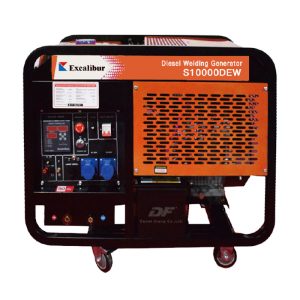
What Is a Welder Generator?
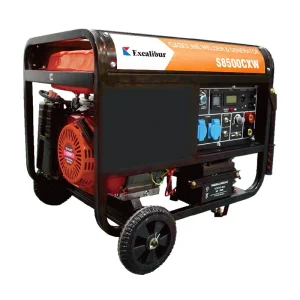
A welder generator (also called a welding generator or generator welder) integrates a generator with a welding machine. This hybrid unit provides both electrical power for welding operations and general electric output for auxiliary tools.
Key Features of Welder Generators:
- Combines welding power source with generator capability
- Typically supports arc welding processes such as SMAW, MIG, or TIG
- Provides auxiliary AC power for tools and equipment
- Engine sizes vary based on required welding output
Common Uses:
- Construction and fabrication sites
- Pipe welding in remote areas
- Maintenance and repair operations
- Agricultural welding tasks
| Pros | Cons |
| Two-in-one capability: welding and power | Higher upfront purchase cost |
| Ideal for jobsites requiring both welding and electricity | More complex maintenance for welding and generator systems |
| Replaces separate welding machine | Output varies under load |
| Heavy-duty construction for rugged environments | Heavier and less compact than standard generators |
Core Differences: Functionality and Purpose
| Feature | Traditional Generator | Welder Generator |
| Primary Function | Generate electrical power | Welding + electrical power |
| Main Output | AC electricity | Welding current (DC/AC) + AC power |
| Typical Users | Homeowners, contractors | Welders, fabricators, industrial users |
| Capacity Focus | Power output (watts) | Welding amperage and power output |
| Complexity | Simple electrical generator | Complex multi-function system |
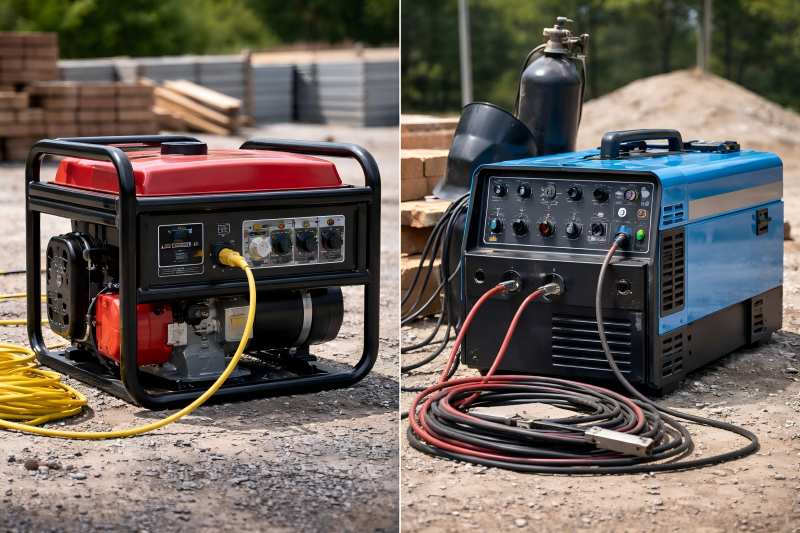
Traditional generators are designed solely for power output. Welder generators, however, are built to support welding operations as the core function and deliver power as a secondary benefit.
Technical Comparison: Performance & Output
Power Output
Traditional Generators
- Rated in watts (W) or kilowatts (kW)
- Output is clean AC for tools and appliances
- Inverter models provide stable voltage for sensitive electronics
Welder Generators
- Rated in amperage for welding output
- Also produces AC power but may not match clean sine wave quality
- Welding output can exceed several hundred amps depending on model
Stability and Quality of Power
- Traditional generator output is usually cleaner, especially in inverter models, making them suitable for electronics.
- Welder generator auxiliary power may have voltage fluctuations when welding load changes — acceptable for tools, but not ideal for sensitive electronics without conditioning.
Duty Cycle and Continuous Use
Welder generators are built to sustain heavy welding loads with solid duty cycles, whereas traditional generators are optimized for steady electrical loads.
Practical Applications
Understanding where each type shines makes buying decisions easier.
Construction and Field Work
- Welder Generator: Excellent for sites needing both welding and power tools — e.g., structural steel work, pipeline welding.
- Traditional Generator: Better for sites focused solely on powering tools or lighting.
Home Backup Power
- Traditional Generator: Ideal for backup power for home appliances, HVAC, refrigerators, and electronics.
- Welder Generator: Can be used, but usually overkill unless welding tasks are required during outages.
Farm and Ranch Use
- Welder Generator: Good choice for on-site repairs, equipment fabrication, fence repair, etc.
- Traditional Generator: Suitable as backup power for barns, pumps, and lighting.
Fabrication Shops
- Welder Generator: Useful if power grid is unreliable or there’s a need for portable welding.
- Traditional Generator: Good for powering shop tools but welding still needs a separate unit.
Detailed Comparison Tables
Technical Specifications
| Specification | Traditional Generator | Welder Generator |
| Output Type | AC only | Welding current + AC auxiliary |
| Rated Power | Typically 1kW–1000kW | Welding amps (e.g., 250–800 A) + AC power |
| Voltage Stability | High (especially inverter models) | Moderate with load changes |
| Welding Capability | ✕ | ✔ |
| Portability | Portable & stationary models | Mostly portable |
| Fuel Types | Gasoline, diesel, propane, NG | Gasoline, diesel |
| Typical Weight | Light to heavy | Heavy due to welding components |
| Maintenance Complexity | Moderate | Higher (generator + welding system) |
Cost Comparison & Ownership
Upfront Costs
Welder generators usually cost more than traditional generators with similar power output because they combine power generation and welding functions.
Ballpark Price Ranges
- Traditional Portable Generator: $500 – $3,000
- Inverter Generator: $900 – $4,000
- Stationary Standby Generator: $3,000 – $15,000
- Welder Generator: $2,000 – $10,000+
Actual prices vary widely based on brand, amps, fuel type, and features.
Operating Costs
- Fuel Consumption: Both types have varying fuel efficiency. Diesel models typically offer higher fuel efficiency.
- Maintenance: Welder generators require additional welding component servicing (e.g., electrodes, cooling systems, regulators).
- Longevity: With proper use, both can last many years. Heavy weld use may shorten generator lifespan if not maintained.
Safety Considerations
Electrical Safety
- Both units require proper grounding and safe wiring practices.
- Welding generators introduce high current circuits — only trained operators should perform welding.
Ventilation and Emissions
Fuel-powered units emit carbon monoxide (CO). Always operate outdoors or in well-ventilated areas.
Load Management
- Overloading a traditional generator can damage equipment.
- Welder generators should not be pushed beyond rated welding amps or auxiliary power capacity.
What to Consider Before Buying
To choose between a traditional generator and a welder generator, ask yourself:
What Is Your Primary Use?
- Power only → Traditional Generator
- Welding + Power → Welder Generator
What Kind of Loads Will You Support?
- Sensitive electronics → choose an inverter generator
- Heavy tools & welding → welder generator
Portability vs Permanent Installation
- Portable needs → many traditional and welder models
- Fixed standby power → typically traditional generators
Budget Constraints
- Lower budgets favor traditional generators
- Mid-to-high budgets may justify welder generator for dual use
Maintenance Capability
Do you have maintenance skills or support? Consider complexity.
Tips for Optimal Use
For Traditional Generators
- Use a surge protector when powering electronics.
- Run periodically to prevent fuel degradation.
- Keep spare oil, filters, and spark plugs.
For Welder Generators
- Maintain electrode holders, ground clamps, and cables.
- Check duty cycle ratings — don’t exceed recommended welding times.
- Use proper PPE (helmet, gloves, protective clothing).
- Perform regular servicing of both welding and generator components.
Case Studies (Common Scenarios)
Scenario 1: Small Farm with Occasional Welding Needs
A small farm needs to power drills, grinders, lights, and occasionally weld gate frames.
Best Choice: Welder Generator
Why: Combines welding capability with power generation for tools.
Scenario 2: Homeowner Prepping for Outages
A homeowner wants to run fridge, lights, charges, and a few power tools during power outages.
Best Choice: Inverter Traditional Generator
Why: Stable voltage for appliances and electronics; welding not needed.
Scenario 3: Remote Construction Site
A remote jobsite requires structural welding, lighting, and powering various tools.
Best Choice: Welder Generator
Why: Dual use saves cost and space; ideal for off-grid worksites.
Traditional generators and welder generators are distinct products with overlapping capabilities. Your choice should be driven by primary use case, load requirements, budget, and environment.
Traditional generators excel in standalone power delivery — especially where sensitive electronics and stable AC are required. Welder generators offer a powerful combination of welding capacity and auxiliary power that’s ideal for construction, fabrication, and repair environments.
In summary:
- Choose a traditional generator for dedicated power needs and electronics support.
- Choose a welder generator for combined welding and power requirements.
- Always evaluate fuel type, output quality, duty cycle, and maintenance needs before purchase.
- With the right selection, you’ll maximize efficiency, cut costs, and ensure performance that meets your work demands.