Natural disasters and major emergencies are happening more frequently and are harder to anticipate. Hurricanes, earthquakes, floods, wildfires, extreme winter storms, and heatwaves can cripple power grids within minutes, leaving entire regions without electricity for days or even weeks.
From hospitals and emergency shelters to water treatment plants, telecom networks, and disaster command centers, diesel generators play a vital, irreplaceable role in disaster response and emergency preparedness.
Why Power Is the First Priority in Any Disaster
Electricity underpins nearly every modern emergency response function. Once the grid goes down, failures spread quickly across critical systems:
- Hospitals lose life-support systems
- Communication networks fail
- Water supply and sanitation systems stop
- Fuel pumps become inoperable
- Emergency coordination becomes chaotic
Without backup power, disaster response efforts are severely compromised. Restoring electricity—even temporarily—becomes the foundation upon which all other recovery actions depend.
Diesel generators are uniquely suited to address this challenge because they provide immediate, on-site, independent power, unaffected by grid damage.
Why Diesel Generators Are Central to Disaster Preparedness
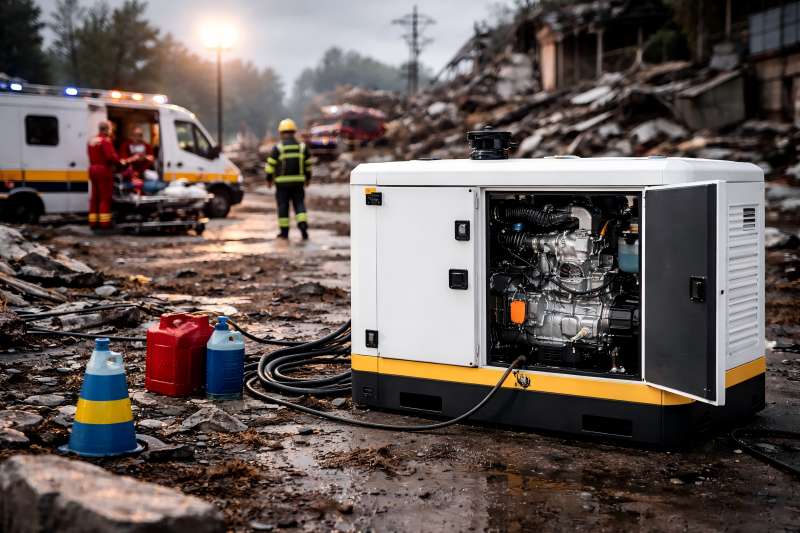
Reliability Under Extreme Conditions
Diesel generators are engineered for harsh environments and heavy-duty operation. Unlike many alternative power sources, diesel generators:
- Start reliably in extreme temperatures
- Operate continuously for long durations
- Tolerate high electrical loads
- Require minimal electronic complexity
This robustness makes them particularly suitable for disaster scenarios, where conditions are far from ideal.
Independence from the Grid
During disasters, transmission lines, substations, and transformers are often damaged. Diesel generators operate entirely independent of grid infrastructure, making them deployable even when power networks are completely destroyed.
This independence allows emergency teams to establish self-sufficient power islands wherever they are needed most.
Key Applications of Diesel Generators in Disaster Response
Diesel generators support a wide range of critical services during emergencies.
Hospitals and Healthcare Facilities
Hospitals are among the most power-dependent facilities in society. During disasters, they must continue operating without interruption.
Diesel generators ensure power for:
- Intensive care units (ICUs)
- Ventilators and life-support systems
- Operating rooms
- Emergency lighting
- Medical refrigeration
- Diagnostic equipment
In many countries, hospitals are legally required to maintain diesel backup generators with sufficient fuel for extended operation.
Emergency Shelters and Relief Centers
Displaced populations depend on shelters for safety and basic needs. Diesel generators provide power for:
- Lighting and heating/cooling
- Cooking and food storage
- Water pumping and sanitation
- Charging communication devices
- Security systems
Reliable power helps maintain order, safety, and dignity during crises.
Communication and Command Centers
Effective disaster response relies on coordination. Diesel generators power:
- Emergency operation centers (EOCs)
- Telecom towers and base stations
- Satellite communication equipment
- Data centers and servers
- Radio and dispatch systems
Without power, emergency coordination becomes fragmented and inefficient.
Water, Wastewater, and Flood Control Systems
Electricity is essential for water infrastructure. Diesel generators keep critical systems running, including:
- Drinking water treatment plants
- Wastewater pumping stations
- Flood control and drainage systems
- Desalination facilities in coastal regions
Failure in these systems can quickly escalate a disaster into a public health crisis.
Why Diesel Over Other Backup Power Options?
While alternative energy sources such as solar, batteries, and natural gas generators have roles in emergency preparedness, diesel generators offer distinct advantages.
Diesel Generators vs Other Emergency Power Options
| Feature | Diesel Generators | Battery Systems | Solar Power | Natural Gas Generators |
| Startup speed | Immediate | Immediate | Delayed | Immediate |
| Runtime | Long (with fuel) | Limited | Weather-dependent | Depends on gas supply |
| Load capacity | High | Moderate | Low–moderate | High |
| Fuel availability | Transportable | Fixed | Sun-dependent | Pipeline-dependent |
| Disaster resilience | Very high | Moderate | Low in storms | Vulnerable to gas outages |
Diesel generators remain the most versatile and resilient option when infrastructure damage is widespread.
Fuel Logistics: A Critical Advantage of Diesel
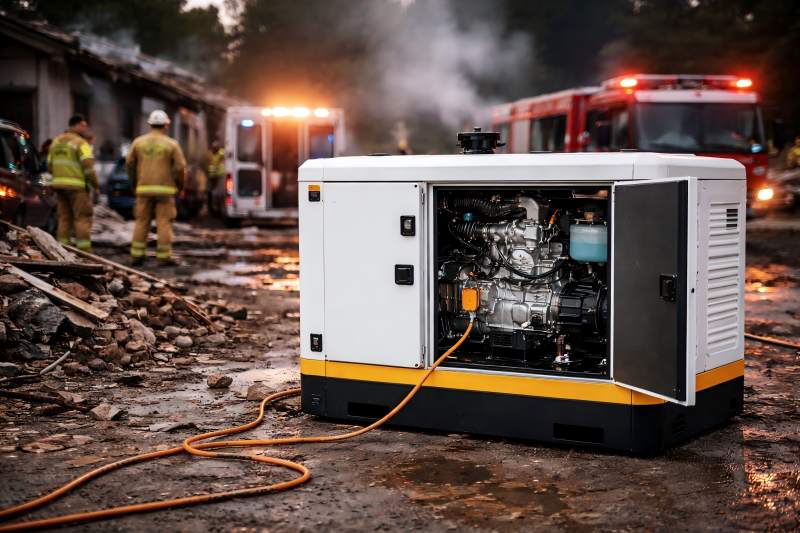
Diesel Fuel Availability
Diesel fuel is extensively utilized across multiple sectors, including transportation, agriculture, construction, and military operations.This widespread usage ensures:
- Established supply chains
- Portable fuel storage
- Compatibility with tanker trucks and mobile fueling units
In disaster zones, diesel can be transported directly to affected areas, even when pipelines or electrical fueling systems are compromised.
Extended Runtime Capability
Diesel generators can run continuously for days or weeks, provided fuel is replenished. This makes them ideal for prolonged disasters, where grid restoration may take significant time.
Mobility and Rapid Deployment
Disasters demand speed. Diesel generators are available in multiple configurations to support rapid deployment:
- Trailer-mounted mobile generators
- Containerized generator sets
- Portable diesel generators
- Skid-mounted industrial units
These systems can be transported by trucks, helicopters, ships, or rail, allowing emergency responders to bring power directly to the point of need.
Scalability: From Small Relief Sites to Large Infrastructure
One of the strengths of diesel generators is scalability.
- Small units power mobile clinics or field offices
- Medium units support shelters and telecom towers
- Large generators supply hospitals, airports, and industrial facilities
Multiple generators can be synchronized to form temporary power plants, providing megawatt-level output when required.
Noise Control and Urban Disaster Response
In densely populated disaster zones, noise can be a concern. Modern diesel generators address this through:
- Sound-attenuated (silent) enclosures
- Advanced exhaust mufflers
- Vibration isolation systems
This allows diesel generators to operate in urban areas, near hospitals and residential zones, without creating additional stress for affected populations.
Maintenance and Readiness: The Hidden Challenge
Emergency power systems are only effective if they work when needed.
Importance of Routine Testing
Diesel generators must be:
- Regularly tested under load
- Maintained according to manufacturer schedules
- Supplied with clean fuel
- Equipped with functional batteries and control systems
Neglecting maintenance can lead to generator failure at the worst possible moment.
Fuel Quality and Storage
Long-term fuel storage requires:
- Proper tanks and filtration
- Additives to prevent degradation
- Regular inspection for water or contamination
Emergency preparedness plans must include fuel management strategies, not just generator installation.
Regulatory Standards and Emergency Compliance
Many governments and institutions mandate diesel generators for critical facilities.
Common requirements include:
- Minimum runtime (e.g., 48–72 hours)
- Automatic transfer switches (ATS)
- Redundant generator systems
- Periodic inspection and certification
Compliance ensures that generators perform reliably during real emergencies.
Environmental Considerations During Disasters
While diesel generators produce emissions, their role in disaster response is primarily life-saving and infrastructure-protecting.
Modern diesel generators mitigate environmental impact through:
- Improved fuel efficiency
- Advanced combustion systems
- Emission control technologies
- Reduced fuel consumption per kWh
In emergency contexts, reliability and human safety take precedence, and diesel generators strike a necessary balance.
Emergency Diesel Generator Preparedness Planning
Effective disaster preparedness involves more than owning a generator.
Key Planning Considerations:
- Correct generator sizing for critical loads
- Redundant systems for mission-critical sites
- Secure and accessible fuel storage
- Trained operators and maintenance staff
- Integration with emergency response plans
Key Roles of Diesel Generators in Disaster Response
| Sector | Role of Diesel Generators |
| Healthcare | Life support, emergency surgeries |
| Emergency services | Command centers, dispatch |
| Utilities | Water, wastewater, flood control |
| Telecommunications | Network continuity |
| Shelters | Safety, lighting, sanitation |
| Transportation | Airports, fuel stations |
Lessons Learned from Real Disasters
Historical disasters consistently demonstrate the importance of diesel generators:
Hospitals that lost backup power faced catastrophic outcomes
Telecom outages delayed rescue coordination
Water system failures led to secondary public health crises
Conversely, facilities with well-maintained diesel generators were able to continue operations and support recovery efforts effectively.
The Future Role of Diesel Generators in Emergency Power
While renewable energy and battery systems will play growing roles in resilience planning, diesel generators will remain essential due to:
- High energy density
- Rapid response capability
- Proven reliability
- Independence from weather and grid conditions
Hybrid systems combining diesel generators with batteries or renewables are increasingly used, but diesel remains the core emergency power source.
Diesel Generators as the Backbone of Disaster Resilience
In emergency preparedness and disaster response, time, reliability, and power availability determine outcomes. Diesel generators provide what few other technologies can: immediate, scalable, durable, and independent electricity under the most extreme conditions.
They power hospitals when lives hang in the balance, keep communication lines open for rescuers, maintain clean water supplies, and restore a sense of order amid chaos. While no technology can prevent disasters, diesel generators ensure that societies can respond, survive, and recover.
For governments, organizations, and communities serious about resilience, diesel generators are not optional equipment—they are a cornerstone of effective emergency preparedness.