However, many buyers make costly mistakes during the selection of portable generator —mistakes that can lead to insufficient power supply, equipment damage, safety hazards, or unnecessary expenses.
Underestimating Power Requirements
One of the most frequent mistakes buyers make is choosing a generator without accurately calculating their power needs.
Portable generators are rated in watts, and there are two key values:
- Starting watts (surge watts): Required to start motor-driven appliances
- Running watts: Required to keep devices operating continuously
- Appliances like refrigerators need much higher starting than running watts.
Sample Power Requirements Table
| Appliance | Running Watts | Starting Watts |
| Refrigerator | 700 W | 2200 W |
| Air Conditioner (1.5T) | 1500 W | 3000 W |
| Microwave Oven | 1000 W | 1000 W |
| Electric Drill | 600 W | 1200 W |
| LED Lights (10 pcs) | 100 W | 100 W |
- Mistake: Only calculating running watts and ignoring surge requirements.
- Solution: Always calculate total load including peak startup demand and add a safety margin of 20–30%.
Selecting an Incorrect Generator Type
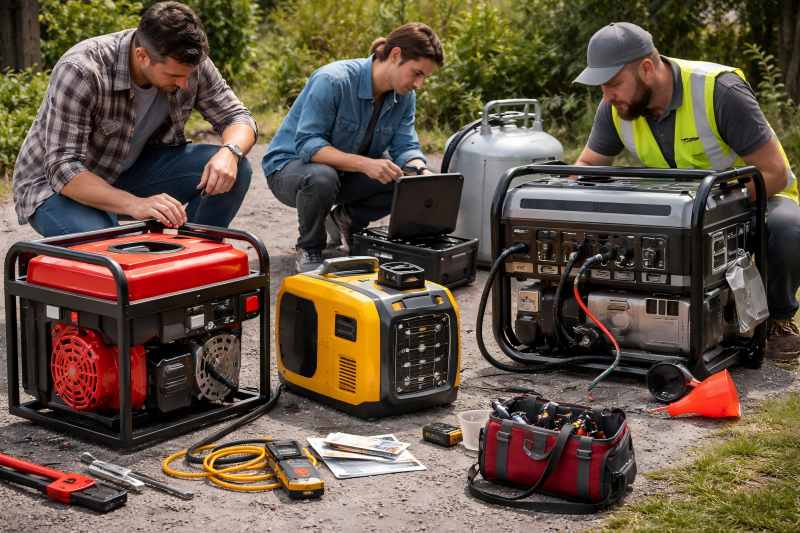
Portable generators differ widely; buyers often choose types unsuited to their applications.
Common Generator Types:
- Conventional Generators: Cost-effective, suitable for heavy-duty use
- Inverter Generators: Stable, clean power delivery
- Dual-Fuel Generators: Operates on gasoline or propane
Comparison Table: Generator Types
| Type | Pros | Cons | Best For |
| Conventional | Affordable, high power output | Noisy, less stable voltage | Construction, industrial use |
| Inverter | Quiet, fuel-efficient, stable output | Higher cost | Electronics, camping, home backup |
| Dual-Fuel | Flexible fuel options | Slightly more complex maintenance | Emergency backup, long runtime |
- Mistake: Using conventional generators to power sensitive electronic devices
- Solution: Choose inverter generators for laptops, TVs, and medical devices.
Ignoring Fuel Type and Availability
Fuel choice significantly impacts operating cost, convenience, and usability.
Common Fuel Options:
- Gasoline
- Diesel
- Propane
- Natural gas (less common for portable units)
Mistake: Choosing a fuel type without considering local availability or storage conditions.
For example:
- Gasoline is widely available but has a short shelf life
- Propane stores longer but may require special tanks
- Diesel is efficient but heavier and noisier
Fuel Comparison Table
| Fuel Type | Advantages | Disadvantages | Storage Life |
| Gasoline | Easy to find, affordable | Short shelf life, flammable | 3–6 months |
| Diesel | Fuel-efficient, durable | Noisy, heavier | 6–12 months |
| Propane | Clean burning, long storage | Lower energy density | Indefinite |
Solution: Select fuel based on availability, runtime needs, and storage conditions.
Overlooking Noise Levels
Noise is a major concern, especially for residential, camping, or urban use.
Generator noise ranges from 50 dB (quiet) to over 90 dB.
Mistake: Ignoring noise specifications and ending up with a generator that disturbs neighbors or violates regulations.
Solution:
- Look for models with low decibel ratings (below 65 dB)
- Consider inverter generators for quieter operation
- Check local noise regulations if applicable
Neglecting Portability and Size
Portable generators differ significantly in size and weight. Some units exceed 100 kg and require wheels or lifting equipment.
Mistake: Choosing an overly heavy or bulky generator for use.
Key Considerations:
- Weight
- Handle design
- Wheel kits
- Compact frame
Solution: For mobile applications, prioritize lightweight designs with ergonomic features.
Ignoring Safety Features
Never compromise safety when operating power equipment.
Essential Safety Features:
- Overload protection
- Low oil shutdown
- Circuit breakers
- Carbon monoxide (CO) detection
Mistake: Choosing cheaper models without proper safety mechanisms.
Solution: Always verify safety certifications and built-in protections.
Not Checking Runtime and Fuel Efficiency
Runtime determines how long the generator can operate on a full tank.
Mistake: Focusing only on power output and ignoring runtime.
Example Runtime Comparison
| Generator Capacity | Fuel Tank | Runtime (50% Load) |
| 2000 W | 4 L | 6–8 hours |
| 5000 W | 15 L | 8–10 hours |
| 8000 W | 25 L | 10–12 hours |
Solution: Choose models with efficient engines and larger fuel tanks if long operation is required.
Overlooking Output Ports and Compatibility
Different devices require different outlet types.
Common Output Options:
- Standard AC outlets
- USB ports
- DC outputs
- RV-ready outlets
- Mistake: Buying a generator that lacks necessary outlets.
Solution: Ensure compatibility with your devices and consider future expansion needs.
Ignoring Maintenance Requirements
Generators require regular maintenance to ensure reliability.
Maintenance Includes:
- Oil changes
- Air filter cleaning
- Spark plug replacement
Mistake: Choosing a generator without considering maintenance complexity or cost.
Solution: Select models with:
- Easy access to components
- Clear maintenance schedules
- Reliable spare parts availability
Prioritizing Price Over Quality
Choosing the cheapest option often increases long-term costs.
Mistake: Buying low-quality generators that fail prematurely or lack efficiency.
Cost vs Value Comparison
| Factor | Low-Cost Generator | High-Quality Generator |
| Initial Price | Low | Higher |
| Lifespan | Short | Long |
| Fuel Efficiency | Poor | Efficient |
| Maintenance Cost | High | Lower |
| Reliability | Low | High |
Solution: Focus on long-term value, not initial cost.
Failing to Consider Future Needs
Many buyers purchase generators based only on current requirements.
Mistake: Buying a generator that cannot support future growth
Solution:
- Add a 20–30% capacity buffer
- Consider parallel capability (for inverter generators)
- Plan for additional equipment
Not Researching Brand and Support
After-sales support is crucial for long-term use.
Mistake: Choosing unknown brands without service networks or spare parts availability.
Solution:
- Check warranty terms
- Evaluate customer reviews
- Ensure access to service centers
Ignoring Environmental Conditions
Generators may be used in various environments:
- Cold climates
- High humidity
- Dusty construction sites
Mistake: Not selecting a generator suited for environmental conditions.
Solution:
- Look for weather-resistant designs
- Consider enclosure or canopy options
- Ensure proper ventilation
Improper Installation and Usage Planning
Even the best generator can fail if used incorrectly.
Mistake: Poor placement, inadequate ventilation, or unsafe wiring.
Best Practices:
- Always operate outdoors
- Maintain proper grounding
- Use transfer switches for home backup systems
Not Understanding Regulatory Requirements
Certain regions have regulations regarding generator emissions, noise, and safety.
Mistake: Purchasing non-compliant equipment.
Solution:
- Check local regulations
- Ensure compliance with EPA or equivalent standards
- Verify certifications
Buying a portable generator is a significant investment that requires careful evaluation of technical specifications, application needs, and long-term considerations. Avoiding common mistakes—such as underestimating power requirements, ignoring fuel types, neglecting safety features, or focusing solely on price—can save you time, money, and operational headaches.
A well-chosen portable generator not only provides reliable power but also enhances safety, efficiency, and peace of mind in both residential and industrial settings. By taking a strategic and informed approach, you can ensure that your generator meets current demands while remaining adaptable to future needs.
If you are sourcing portable generators for commercial or industrial applications, working with an experienced supplier can further help tailor the solution to your exact requirements, ensuring optimal performance and long-term reliability.