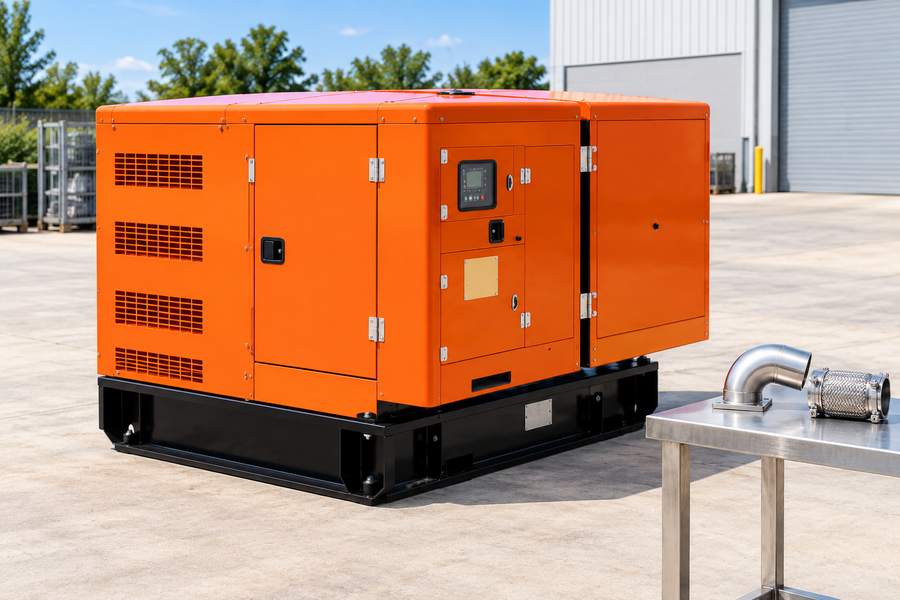
You should extend a silent diesel generator’s exhaust only when the generator or engine manufacturer approves a complete, model-specific arrangement and qualified personnel design and install it. Approval needs to cover exhaust restriction, temperature, materials, support, vibration, expansion, drainage, termination, and the effect on the enclosure. A pipe that fits the outlet is not enough evidence that the modification is suitable.
An exhaust extension also does not make a portable generator safe to operate indoors. The portable generator itself still belongs outdoors, positioned and operated within the restrictions in its manual. If the intended application requires a purpose-designed stationary installation, obtain equipment and engineering support appropriate to that application rather than converting a portable set with an improvised hose.
Describe The Site Problem Before Drawing The Pipe Route
Start the approval request with the reason the supplied exhaust arrangement does not fit the proposed site plan. The reason might be discharge direction, a site layout constraint, a proposed enclosure, or noise at a receiver. Different problems may require different solutions, and an extension may not be the best one.
Provide a drawing or photographs of the intended location, nearby buildings, air openings, occupied areas, and the proposed route. Include the generator’s cooling-air openings and service access. The supplier needs to understand the complete arrangement rather than only the desired pipe length.
Ask first whether modification is permitted on the selected model. Some packaged generators are intended to retain their supplied exhaust system. A manufacturer’s refusal or lack of an approved arrangement should not be replaced with a generic aftermarket compatibility claim.
When reviewing Excalibur’s silent diesel generator options, raise the exhaust requirement before ordering. The approved configuration may affect which model is suitable. Keep the response linked to the exact engine, canopy, and electrical version.
Obtain The Engine’s Exhaust Design Limits
Request the relevant exhaust-flow, temperature, and allowable-restriction data from the manufacturer. The designer needs the conditions associated with those values, including the operating point. Limits from another engine of similar power are not an adequate substitute.
The assessment must consider the complete exhaust path. Existing silencers, added pipe, bends, flexible sections, outlet devices, and other components can each contribute resistance. Evaluating only the new straight section can miss an unacceptable total.
Do not choose diameter from outlet fit alone or assume that a short flexible hose creates negligible resistance. The geometry and component characteristics matter. Ask for the approved calculation or engineering assessment and the commissioning measurement required to validate it.
Keep units explicit in all documents. Pressure values expressed in different units can be confused, and a mistaken conversion can invalidate the comparison. The approval record should identify the limit, calculated result, measurement point, and test condition clearly.
Use Components Intended For Engine Exhaust
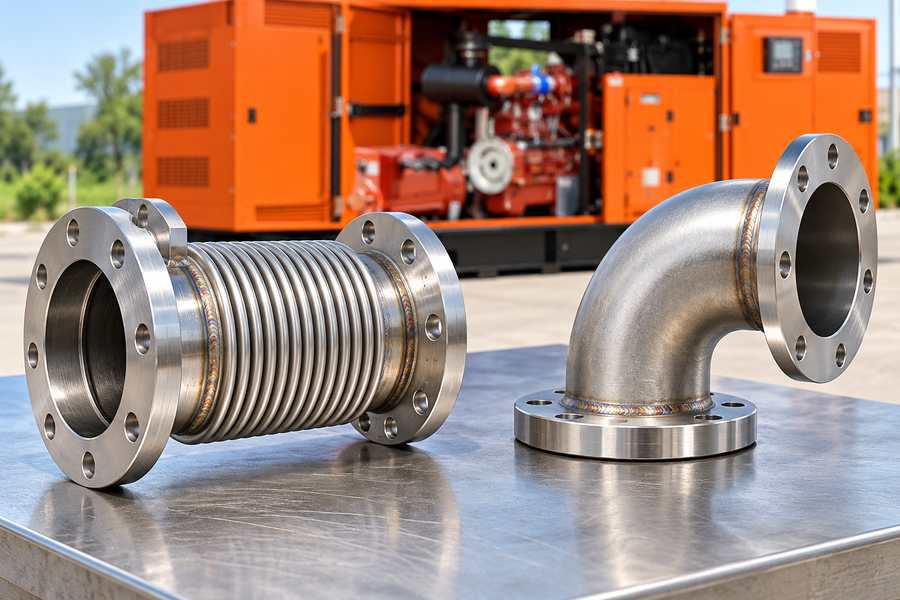
Ask the designer to specify the pipe, joints, flexible connectors, silencer, and outlet components. They must be suitable for the temperature, vibration, corrosion exposure, and operating duty. A hose intended for ventilation or another low-temperature service is not an acceptable substitute.
Confirm the attachment method at the generator. Improvised clamps or adapters can leak, loosen, or load the original outlet incorrectly. The connection should be part of the approved design rather than a workshop decision made after the rest of the system is installed.
Do not assume that a component described as universal has been approved for the specific generator. Ask which data support its use in the proposed arrangement. Compatibility includes more than matching a nominal diameter.
Keep a bill of materials with the approval documents. This helps prevent later substitutions that change restriction, temperature capability, or mechanical behavior. If a specified component is unavailable, have the replacement reviewed before fitting it.
Design Support And Movement Together
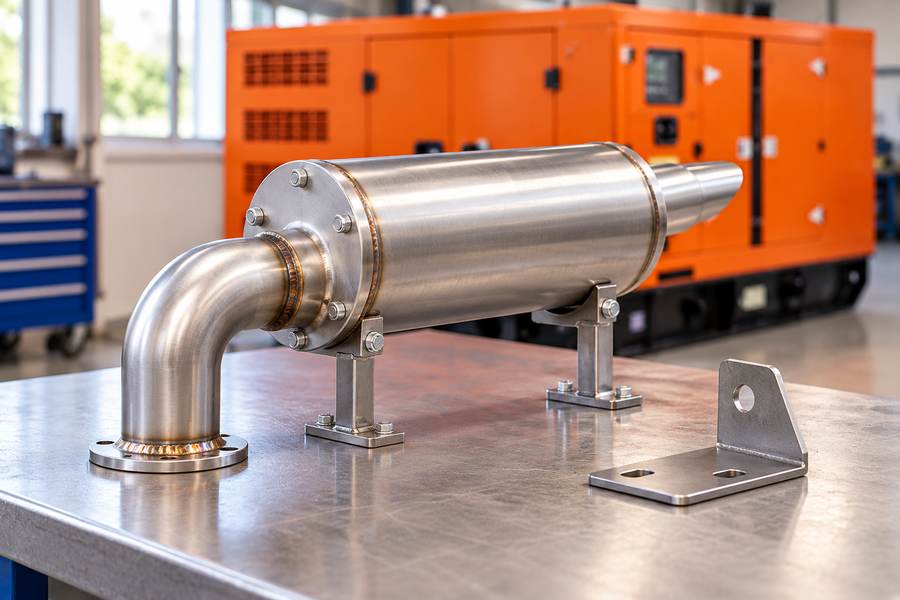
The added system needs appropriate support. Do not make the engine outlet or silencer connection carry an unassessed pipe load. The designer should identify supports and explain how the arrangement handles the weight and forces involved.
Generator vibration and movement during starting, stopping, and load changes must be considered. A flexible connector, where specified, has a defined installation and movement capability. It should not be treated as a cure for arbitrary misalignment.
Thermal expansion is another separate movement. Exhaust components change dimensions as they heat and cool, and the installation must accommodate that behavior. A rigid connection between the generator and a fixed structure can create stress if the design ignores movement.
Ask how the assembly will be inspected after installation. Supports, joints, and flexible components should remain accessible for the prescribed checks. A route hidden behind permanent construction may make later maintenance difficult.
Preserve Hot-Surface Clearances And Enclosure Function
Identify nearby combustible materials, cables, hoses, insulation, and surfaces people can touch. The designer must specify appropriate clearances, guards, and any approved thermal protection. Do not wrap the exhaust with an arbitrary material to compensate for an unsuitable route.
Any penetration through the canopy or another structure requires review. It can affect heat transfer, weather protection, noise, structural integrity, and service access. A neatly cut hole is not evidence that those effects have been assessed.
Keep cooling-air paths intact. The extension and its supports must not obstruct louvers, radiator discharge, or service panels. Heat radiated from the new route also needs consideration within the enclosure and nearby installation.
Do not confuse exhaust gas with cooling-air discharge. A system that routes engine exhaust correctly may still leave the generator overheating if cooling air is restricted or recirculated. Both systems need an appropriate installation.
Address Rain Entry And Condensate
Ask how the approved system prevents unwanted water entry and manages condensate. The answer should include the route, outlet arrangement, any collection or drainage provisions, and the maintenance procedure. Avoid leaving these details to the installer after pipe sizing is complete.
Water must not be allowed to collect or travel toward the engine in a way the manufacturer prohibits. Have the designer assess drainage for the actual elevations, route, and exhaust components shown on the installation drawing. Do not adopt a generic slope, drain hole, or rain-cap arrangement without checking its suitability.
Drainage features must remain accessible and be managed safely. Exhaust condensate can be contaminated and should not be discharged casually into the work area. Include inspection and handling requirements in the operating documentation.
A rain cap or outlet device can also affect restriction and discharge behavior. Include it in the design assessment rather than adding it later as a harmless accessory. Review any proposed replacement through the same process.
Choose A Safe Discharge Location
The termination must keep exhaust away from people, building openings, ventilation intakes, and other locations where gases could accumulate or re-enter. Consider wind, nearby structures, and the full range of site use. An outlet that points away from one door may still affect another opening.
Do not use an extension to justify placing a portable generator in a garage, shed, vehicle, or other enclosed area. Leaks and heat remain concerns, and the machine still needs its approved cooling arrangement. An exhaust pipe leading outside does not turn that space into a suitable installation.
Do not connect the generator to a shared exhaust path without an explicitly engineered and manufacturer-approved arrangement. Other equipment and idle branches introduce additional risks and design questions. A spare chimney or existing duct should not be assumed suitable.
Have applicable installation and environmental requirements identified by qualified personnel. The manufacturer can approve its equipment arrangement, but site compliance may require additional review. Keep those responsibilities clear in the project documents.
Review Noise, Emissions, And Warranty Implications
Moving the outlet may change where exhaust noise is heard without solving engine, fan, or panel noise. If the goal is acoustic improvement, assess the complete generator and receiver location. Avoid promising a particular reduction based only on pipe length.
An added silencer can change both acoustic performance and exhaust restriction. Request the component specifications and the generator manufacturer’s acceptance for this exhaust duty. A quieter-sounding demonstration does not prove that the engine remains within its limits.
Ask whether the modification affects the equipment’s emissions configuration, approvals, or warranty terms. Obtain a response from the responsible manufacturer or authorized representative. A reseller’s statement that customers commonly fit the part is not equivalent to approval.
Record any operating restrictions that accompany the approved modification. The final machine should have clear documentation so a later owner does not remove, extend, or rearrange components without understanding their purpose. Keep the original and revised configuration records.
Require Installation And Commissioning Evidence
Agree who will install the system and who will verify it. The work should follow the approved drawings and component specifications. Document deviations and obtain review before operation.
Commissioning should include the checks required by the manufacturer, such as leakage, mechanical integrity, relevant exhaust restriction, and operation under the specified load. Use qualified personnel and suitable instruments. Do not check for leaks by touching hot joints or placing yourself in the exhaust stream.
Verify that guards, service access, weather protection, and cooling paths remain correct. Inspect the arrangement after the prescribed operating and cooling cycle where required. A system that fits when cold may behave differently after heating.
| Approval item | Evidence to request |
| Permission for modification | Written response tied to the exact generator and engine |
| Flow and restriction | Design data, complete-system assessment, and validation method |
| Mechanical arrangement | Component list, supports, movement provisions, and connection details |
| Thermal and enclosure effects | Clearances, guarding, penetrations, and cooling review |
| Water management | Rain and condensate provisions with maintenance access |
| Site discharge | Approved termination and review of nearby openings and occupancy |
| Return to operation | Installation record and completed commissioning checks |
Keep The Original Configuration Until Approval Is Complete
A useful approval request describes the whole route in sequence: original connection, proposed flexible section, straight runs, bends, any additional silencer, supports, and termination. Include dimensions and component identities rather than a photograph of a coiled hose. The designer can then assess the proposal without guessing what will be installed.
State whether the generator will remain fixed or be moved between jobs. A permanent exhaust connection can conflict with the handling expectations for a portable machine. The approval must explain any disconnection, inspection, and reconnection steps required when the equipment changes location.
Also identify who controls future changes. If a site team later adds another bend to clear a new barrier, the installed system may no longer match the approved arrangement. Keep a drawing at the equipment and require review of changes that affect the route, components, support, or discharge location.
These records make maintenance practical as well as supporting the original installation. A technician can identify the specified joint or connector and inspect the intended arrangement without reconstructing its design from unmarked parts.
If the manufacturer has not approved the proposal, leave the exhaust system as supplied and reconsider the site arrangement or equipment choice. The broader diesel generator range may offer a configuration better suited to the intended application. Selection is often easier to resolve before purchase than after a machine has been modified.
Provide the supplier with the model, serial number, operating duty, site drawing, proposed route, and reason for the change. Ask for a complete decision and the supporting installation requirements. That gives the project a reviewable design instead of a collection of fittings whose combined effect has never been checked.