
Ride-On Power Trowels: How to Choose the Right Model for Large-Scale Concrete Projects
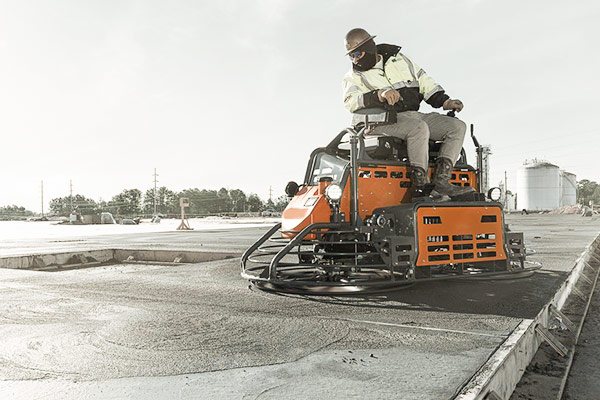
Ride-on power trowels are the workhorses of modern slab finishing. When you’re chasing flatness numbers, battling deadlines, and working across thousands of square feet, the right machine can shave hours off the schedule, reduce crew fatigue, and materially improve FF/FL results. What a Ride-On Trowel Actually Does A ride-on trowel consolidates, densifies, and smooths the surface of fresh concrete using two counter-rotating rotors (most common) or one large rotor (less common). Operators start with pans for floating to embed aggregate and close voids, then switch to finish blades for sealing and polishing. On big floors, the time window between “too wet” and “too hard” is short. Machine speed, coverage width, maneuverability, and blade pressure determine whether you finish on time—or chase burn lines all night. Core outcomes you’re buying: Throughput: square feet (or m²) per hour per machine/crew Flatness: ability to hit FF/FL targets with fewer corrective passes Consistency: uniform sheen and edge-to-edge density Cost control: lower labor per square foot and reduced rework What They Mean in Practice Rotor Diameter & Count Common configs: dual 36″, dual 46″ (most prevalent), and heavy-duty 60″+ class. Impact: Larger diameter = fewer lanes for a given slab = higher throughput. But bigger machines are heavier and need more open space and straighter runs. Drive Type: Mechanical vs. Hydrostatic Mechanical: Direct belts/gearbox. Lighter upfront cost, good feedback, fewer hydraulic components. Hydrostatic: Smooth, precise control, variable speed, excellent for high-FF finishing and tight maneuvering; typically higher purchase price and maintenance skill requirements. Power & Fuel Gasoline: Common, lighter, widely available. Diesel: More torque for big rotors and long shifts; heavier; emissions considerations (especially indoors). LPG (Propane): Cleaner emissions for enclosed spaces; logistics for fuel swaps. Horsepower: Typical ride-on range 20–80+ hp depending on class. Blade/Pan System Pans: 10- or 11-gauge pans, 5- or 6-lug patterns. Finish blades: 4/5/6-blade spiders; larger finishing area raises production but needs adequate horsepower. Speed & Pitch Control Rotor speed: ~60–165 rpm typical. Higher top speed helps sealing; low-speed torque helps float phase. Pitch control: Manual levers or electric/hydraulic; repeatability matters for FF/FL. Weight & Down Pressure Heavier machines can achieve better densification and faster sealing if the concrete is ready; they also sink if you jump the gun. Balance weight with slump/bleed characteristics and ambient weather. Ergonomics & Safety Suspension seat, low-effort controls, LED lighting for night pours, deadman shutdown, cage and guarding, E-stop, and backup alarms. Maintenance Access Pan/blade swap speed, belt/hydraulic service points, filters, and diagnostics. The best machine is the one your crew keeps in spec. How Big a Trowel Do You Need? Below are typical production rates on open floors with experienced operators and a well-planned pour. Your actual rates depend on mix design, set times, crew size, pass count, and site constraints. Dual 36″ class: ~6,000–9,000 ft²/hr (560–830 m²/hr) during float phase; finishing ~4,000–6,000 ft²/hr (370–560 m²/hr) Dual 46″ class: ~8,500–12,000 ft²/hr (790–1,115 m²/hr) float; finishing ~5,500–8,000 ft²/hr (510–740 m²/hr) Heavy 60″+ class: ~10,000–14,000+ ft²/hr (930–1,300+ m²/hr) float; finishing ~7,000–10,000 ft²/hr (650–930 m²/hr) Rule-of-thumb: One dual-46″ ride-on plus one 36″ support machine per ~20,000–30,000 ft² (1,850–2,800 m²) placement window is a common starting point for distribution centers and big-box retail slabs. Quick Selection Matrix Project Type Slab Size per Pour Flatness Target (FF/FL) Obstacles/Columns Recommended Drive Rotor Class Power/Fuel Notes Warehouses/DCs 20,000–60,000 ft² FF 45–60 / FL 30–40 Low Hydrostatic Dual 46″ Diesel or Gas High throughput; pair with walk-behinds for edges Big-Box Retail 10,000–30,000 ft² FF 35–50 / FL 25–35 Moderate Hydrostatic Dual 46″ Gas/LPG Maneuvering around columns; lighting important Parking Decks 8,000–20,000 ft² FF 25–35 / FL 20–25 High Mechanical Dual 36″ Gas Tighter spacing, lighter machine; watch weight limits Industrial/Heavy 30,000–80,000 ft² FF 50–70 / FL 35–45 Low Hydrostatic 46″+ / 60″+ Diesel Heavy machine for dense, flat finish; skilled crew Interiors w/ Vent Limits 5,000–20,000 ft² FF 35–50 / FL 25–35 Moderate Hydrostatic Dual 36″–46″ LPG Emissions control indoors; quick pan swaps Model Comparison Data The table below shows representative values by machine class—not tied to a specific brand. Use these bands to sanity-check vendor quotes. Parameter Dual 36″ Class Dual 46″ Class Heavy 60″+ Class Typical Rotor Diameter 36 in (915 mm) 46 in (1,168 mm) 60–65 in (1,524–1,651 mm) Overall Path Width ~72–78 in ~92–100 in 120+ in Engine Power 20–35 hp 30–55 hp 55–80+ hp Drive Type Options Mechanical/Hydro Mostly Hydro Hydro Rotor Speed Range 60–150 rpm 60–165 rpm 60–165 rpm Dry Weight 700–1,000 lb (320–450 kg) 1,000–1,500 lb (450–680 kg) 1,800–2,800 lb (815–1,270 kg) Fuel Gas/LPG Gas/Diesel/LPG Diesel/Gas Float Productivity* 6k–9k ft²/hr 8.5k–12k ft²/hr 10k–14k+ ft²/hr Finish Productivity* 4k–6k ft²/hr 5.5k–8k ft²/hr 7k–10k ft²/hr Typical Use Tight spaces, decks General large slabs Massive pours, open runs Calculate Machines Needed for Your Pour Quickly estimate the number of ride-on trowels required for each finishing phase, from floating to final sealing. Plan for the slower of the two. Inputs you know: AAA = Pour area (ft²) TTT = Effective finishing window (hours) — from “ready” to “too hard” PPP = Expected productivity (ft²/hr per machine) for your machine class and phase Machines required: N=A/T×P Example: Area A=30,000A = 30,000A=30,000 ft² Time window T=2.5 hr Dual-46″ finish productivity P=6,500P = 6,500P=6,500 ft²/hr N=(30,000/2.5×6,500)=(30,000/16,250)=(1.85)=2 ride-ons (plus a walk-behind for edges) Pro tip: many crews stage one additional ride-on as a contingency when weather or set times are unpredictable. Hydrostatic or Mechanical? Choose hydrostatic when: You’re targeting high FF/FL values over large, open slabs Operators want ultra-smooth control to avoid swirl marks and overwork You’re frequently switching between float and finish speeds Choose mechanical when: Budget is tight and floor geometry is complex (parking decks, column forests) You prefer simplified maintenance with fewer hydraulic components Your crew already excels with mechanical feel and feedback Pans, Blades, and Pass Strategy Pans: Start floating once bleed water is gone and footprints sink ~¼” or less. For big slabs, 11-gauge pans with robust lugs minimize flex and keep consistent contact. Push overlapping lanes by ~6–8″ to avoid ridges. Blades: Transition to combination or finish blades when the slab supports