Choose a water pump by the flow it can deliver against your system’s required head, using the performance curve for the offered model. Elevation, hose friction, fittings, and pressure needed at the outlet all affect that requirement. Maximum head and maximum flow are separate endpoints, so a pump cannot normally deliver both advertised maxima at once.
A long hose and an uphill discharge can change a promising specification into a weak stream at the work area. The useful question is how much water reaches the destination under the actual installation conditions. The selection process below starts with measurements from the proposed hose route and finishes with a request for documented pump performance.
What Do Delivery Volume and Head Reveal About a Water Pump?
Flow rate describes the volume moved in a given time, commonly expressed in liters per minute or cubic meters per hour. Head expresses energy per unit weight of liquid as an equivalent height, commonly stated in meters. These quantities describe different aspects of the same operating point.
For water transfer, a higher flow rate can shorten filling time, while sufficient head allows the system to overcome elevation and resistance. Neither number alone establishes suitability. A pump with an impressive free-discharge volume may produce too little flow through a restrictive uphill line.
Keep the units consistent when comparing quotations: one cubic meter contains 1,000 liters, and one hour contains 60 minutes. For example, 6 cubic meters per hour equals 100 liters per minute. That conversion does not change the pressure or head requirement associated with the flow.
Which Parts of the Installation Determine Required Head?
For a common arrangement transferring water between open containers, begin with the difference between the source and destination water levels. Add the losses along the flow path at your target flow. If the outlet device needs pressure, include that requirement in the calculation as well.
| Item | Information to Collect — Effect on Selection |
| Elevation | Lowest source level and required delivery level — Changes the static lift |
| Hose | Actual inside diameter, length, and construction — Determines part of the friction loss |
| Fittings | Bends, valves, reducers, and strainers — Adds local resistance |
| Outlet | Required pressure and target flow — Defines the useful delivery condition |
| Water source | Temperature, debris, and suction arrangement — Affects inlet conditions and pump suitability |
The Hydraulic Institute’s explanation of pump system curves describes how static requirements and friction combine. A system curve changes with flow; it is more informative than a single height measurement. For installations involving pressurized vessels or significant velocity differences, have the complete energy balance evaluated.
Does a 100-Meter Hose Require 100 Meters of Head?
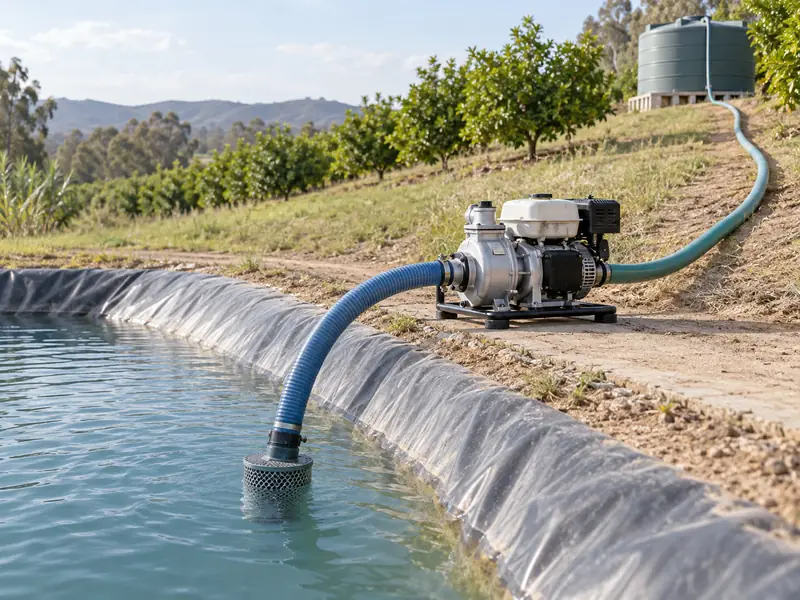
The length measured along level ground is not an equivalent elevation rise; its hydraulic effect must be calculated from the resistance of the flowing line. A horizontal hose still creates friction as water moves through it, but the loss depends on its diameter, flow, material, and fittings. The same length can cause very different losses in two installations.
Measure the inside diameter rather than relying on an ambiguous hose description. A reducer or undersized coupling can also restrict a line that otherwise appears adequately sized. Give the supplier the complete route and connection sizes, including temporary adapters.
Why Must You Compare a Pump Curve With the System?
The performance curve shows how available head changes as the pump delivers different flow rates at a stated speed. Where it meets the system curve is the predicted operating point. Changing hose resistance, water level, or operating speed can move that point.
The Hydraulic Institute’s combined pump and system curve explanation illustrates this relationship. Use a curve for the offered impeller, speed, and configuration. A curve from another model in the same catalog is not enough to confirm delivery.
Maximum head generally refers to the shutoff end of a centrifugal pump curve, where useful delivery approaches zero. Maximum flow is associated with much lower head under the supplier’s stated conditions. Treating the two maxima as one operating point can produce a substantial selection error.
How Would a Simple Planning Example Work?
Suppose a hypothetical irrigation line needs 100 liters per minute, with 12 meters of elevation difference. Assume a calculation for the actual hose and fittings gives 8 meters of loss at that flow, and the outlet needs pressure equivalent to another 10 meters of water. The preliminary requirement is therefore 30 meters of head at 100 liters per minute.
These numbers demonstrate the method; they are not measurements or predictions for an Excalibur model. The next step is to find the proposed pump’s curve and check its delivery at that point. Selecting a unit merely because its maximum head exceeds 30 meters would leave the required flow unverified.
Repeat the assessment for realistic variations, such as a falling source level or additional hose sections. Ask the supplier to explain the allowance used for uncertain losses. Excessive oversizing also deserves review because the resulting operating point may be unsuitable.
Does Your Delivery Point Require a Pump Built for Greater Pressure?
A high-pressure configuration deserves consideration when substantial elevation or outlet pressure dominates the job. It still needs adequate flow at the required head. Compare the curve and operating limits rather than using the product category as a guarantee.
Excalibur’s high-pressure water pump range provides candidate models for that discussion. Send the required operating point and request confirmation for the exact quoted unit. Also check the pressure ratings of hoses, couplings, valves, and terminal equipment.
For more general transfer duties, review the gasoline water pump range against the same calculation. Engine fuel and pump hydraulic performance answer different purchasing questions. Our guide to comparing water pump types gives additional context for organizing the choices.
Can Changing the Hose Improve Delivery?
Often, yes: a larger suitable inside diameter, a shorter route, or fewer restrictive fittings can reduce losses. Recalculate the system at the desired flow before deciding that the pump itself must be replaced. Diameter changes can be particularly important on long discharge runs.
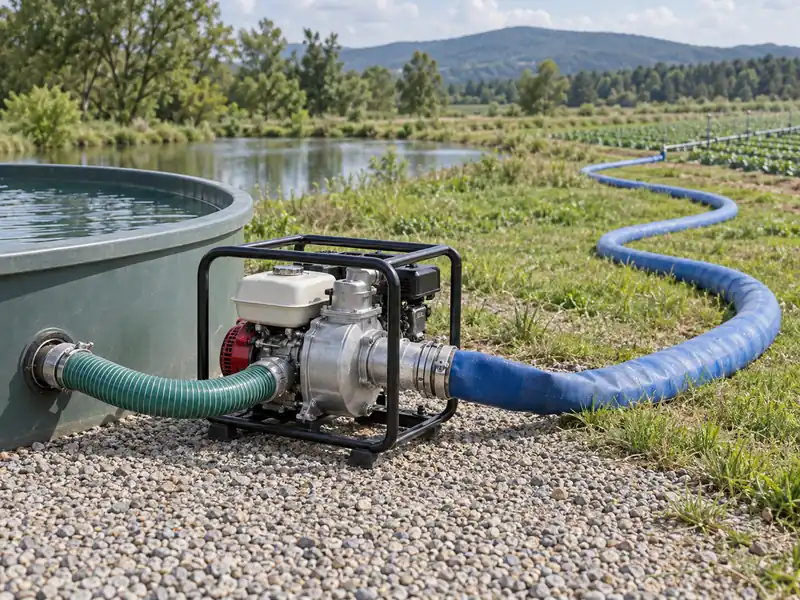
Lay out the proposed route and record every section rather than treating the installation as one uniform hose. Check bends for kinks and flexible sections for deformation. A partly closed valve or obstructed strainer can cause poor delivery even when the original selection was reasonable.
- Measure hose length and inside diameter for each section.
- Identify reducers, branch connections, valves, and outlet devices.
- Check component working-pressure ratings against possible system conditions.
- Compare the calculated delivery before and after a proposed change.
- Verify the result with a suitable flow measurement during commissioning.
Why Does the Suction Side Need a Separate Check?
A discharge-head rating does not establish how far a pump can lift water into its inlet. Suction performance depends on atmospheric conditions, water temperature, inlet losses, and the pump’s requirements. Confirm the proposed inlet arrangement with the manufacturer, because the conditions behind a published suction rating may differ from those at your water source.
Provide the vertical distance from the lowest expected water level to the pump inlet and describe the suction hose. Use the specified suction-rated components, maintain airtight connections, and follow the manufacturer’s priming instructions. Place and maintain the strainer as directed to limit blockage and air entry.
Cavitation risk requires comparing available inlet conditions with the pump’s required net positive suction head, with an appropriate margin. Ask the supplier to assess that comparison where suction lift or hot water makes the arrangement demanding. Do not attempt to solve an inlet problem simply by choosing a larger discharge rating.
What Should the Supplier Receive Before Final Selection?
Turn the installation into a short specification that another person can reproduce. Include both normal duty and the most demanding expected condition. Our broader guide to choosing the right water pump can help organize application details.
- State the target flow and explain whether it serves filling, irrigation, drainage, or another duty.
- Provide source and delivery levels, including expected changes during operation.
- List suction and discharge dimensions, fittings, and terminal pressure requirements.
- Describe water quality, temperature, operating hours, and site altitude.
- Request the exact performance curve and a written assessment of the proposed operating point.
At commissioning, retain a dated record of measured delivery, pressure readings, and the installed hose arrangement for later troubleshooting. If delivery declines, inspect the system and compare conditions before ordering replacement equipment. The discussion of water pumping and resource conservation provides a wider reason to avoid unnecessary pumping and wasted water.
A sound selection connects the job’s required delivery to documented hydraulic performance. Once elevation, resistance, inlet conditions, and outlet demand are clear, the supplier can recommend a configuration with a defensible operating point. That is considerably more useful than comparing two maximum numbers in isolation.