Choose a welder generator by the welding output it can sustain for your work pattern, not by maximum amperage alone. Duty cycle links a specified welding output to an allowed operating time and cooling interval under stated test conditions. To compare machines fairly, match the current, voltage, process, ambient conditions, and rating period.
A repair team making occasional short welds and a fabrication crew depositing long runs may need different machines even when both use the same electrode. The useful purchasing question is how much welding the equipment can support during the busiest repeated part of the job.
What Does Duty Cycle Mean on a Welder Generator?
For a rating based on ten minutes, a 60% duty cycle allows six minutes of welding at the stated output followed by the required cooling time within that rating framework. A 100% rating supports welding throughout that interval at its specified output and conditions. Neither statement grants permission to exceed the machine’s current, temperature, or operating limits.
The Universal Technical Institute explanation of welding duty cycle provides a useful introduction to the relationship between operating time and cooling. Always use the supplied machine’s manual for the actual rating basis and cooling procedure.
The percentage must travel with its amperage and voltage. “60% duty cycle” is incomplete if the quotation does not say at what output it applies.
Likewise, the upper end of an adjustment range is not necessarily the output available continuously.
How Do You Read a Rating Without Overinterpreting It?
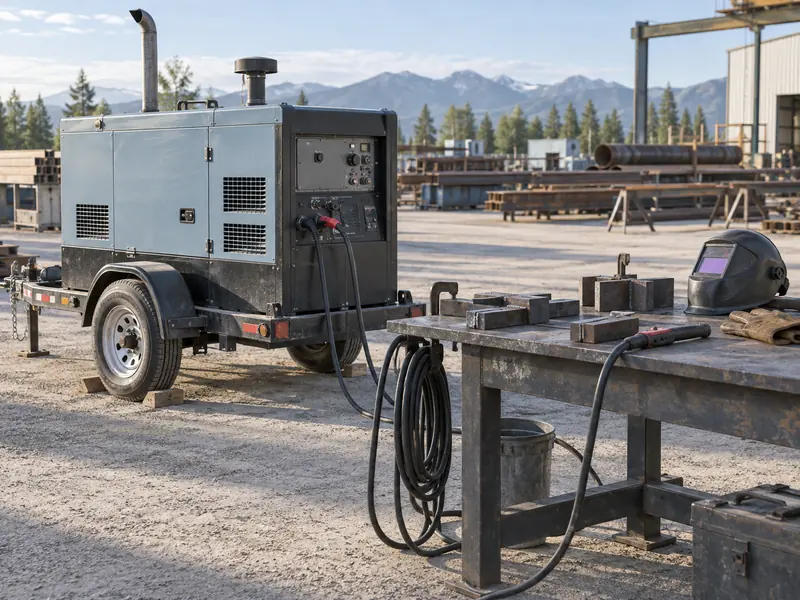
Consider an illustrative machine rated at 250 A and a specified welding voltage at 60% over ten minutes. The rating describes a six-minute welding allowance followed by the prescribed cooling interval; it does not promise ten minutes at 250 A. It also says nothing about a different current setting until you consult the duty-cycle curve or manufacturer data.
Do not scale the ten-minute example into an hour of uninterrupted welding followed by a long rest. Thermal behavior depends on the rating period and cooling conditions. The engine’s ability to keep running does not remove the welding system’s thermal limits.
How Is Welding Duty Cycle Different From Generator Runtime?
Fuel-tank runtime describes how long the engine may operate at a stated load before refueling. Welding duty cycle describes a thermal operating limit at specified welding output. Auxiliary AC power has its own electrical ratings, so these three figures should be checked separately.
| Specification | What It Describes — What to Verify |
| Welding current range | Available adjustment range — Rated duty cycle at the current you need |
| Welding duty cycle | Allowed welding time at specified output — Period, voltage, temperature, and cooling instructions |
| Auxiliary power | AC supply for tools or other loads — Continuous rating, sockets, and simultaneous-use limits |
| Fuel runtime | Time between refueling under stated conditions — Load basis and operating procedure |
Our comparison of welder generators and ordinary generators explains the equipment categories. Once that distinction is clear, keep the welding and auxiliary-power requirements in separate columns on your purchasing sheet.
How Can You Estimate the Duty Your Job Requires?
Observe a representative work sequence and record actual arc-on time. Include fit-up, electrode changes, cleaning, inspection, and repositioning, but pay attention to the busiest repeated interval rather than the average across an entire shift. Long breaks at lunchtime do not compensate for an overloaded welding period earlier in the day.
What Would Two Different Work Patterns Look Like?
Imagine a maintenance task with several brief welds separated by adjustment and inspection. Its arc-on time may be modest even though the machine remains running nearby. A repeated fabrication seam can demand a much greater proportion of each working interval.
As an example only, four minutes of arc time during a ten-minute observation equals 40% utilization for that observation. This is a workload estimate, not a certification that any 40% rated machine is suitable. Confirm the required welding output, the longest continuous run, and repeated behavior over subsequent intervals.
- Identify the welding process and approved procedure for the work.
- Record the expected current and voltage, not only the electrode diameter.
- Measure typical and peak arc-on periods during representative production.
- List auxiliary tools that may operate while welding continues.
- Describe the ambient temperature, altitude, dust, and installation arrangement.
For a process overview, our welder generator operating guide provides related preparation steps. The welding procedure and equipment manual remain the references for the actual job.
Why Does Higher Current Often Reduce Available Welding Time?
Increasing current raises thermal stress in the welding circuit and associated components. Many machines therefore offer a lower duty-cycle percentage near their highest outputs and a higher percentage at reduced outputs. Read the model-specific curve instead of estimating an unrestricted continuous rating from a single percentage.
A calculated estimate can help an engineer discuss a requirement, but it should not replace the manufacturer’s published limits. Cooling design, controls, and component ratings can impose constraints that a simple arithmetic relationship misses. Never use a calculation to justify operating above the machine’s approved range.
Excalibur’s diesel welder generator range is a starting point for selecting an output class. Ask for the duty-cycle data at your working current before finalizing a model, especially if continuous fabrication matters more than occasional repair.
Can You Weld and Run Power Tools at the Same Time?
Only assume simultaneous operation when the manufacturer confirms the available combination of loads. Welding output and auxiliary AC output may share engine and electrical capacity. Adding their separate maximum ratings can overstate what the machine can deliver together.
A grinder starting during a weld introduces a changing load, not merely its steady running demand. Send the supplier both the welding requirement and the tools’ input ratings. Request a combined-load table or written operating limits for the quoted configuration.
What Changes With Two Welding Operators?
Two output terminals do not automatically mean two independent full-capacity welding stations. Check the allowed current for each operator, the combined output, and the duty-cycle basis when both arcs are active. Also confirm whether their settings can be controlled independently.
The Excalibur high-output diesel welder generator page includes configurations relevant to heavier and multiple-operator work. Treat the page as a product introduction and request an approved specification sheet for the exact configuration, rather than assigning one model’s capability to the entire range.
How Do Cooling and Accessories Affect the Usable Setup?
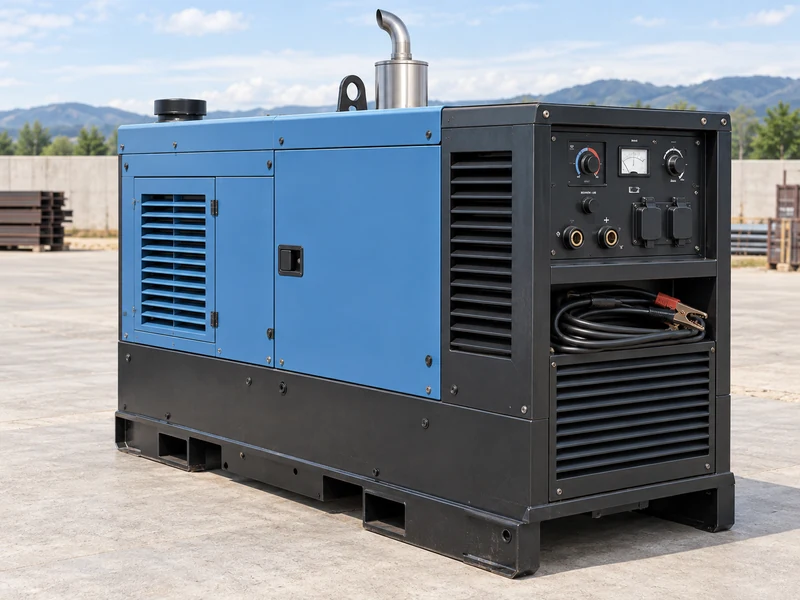
Keep the machine’s specified airflow paths and service clearances unobstructed. Hot surroundings, accumulated debris, or unsuitable placement can undermine cooling. Follow the manual’s instructions after thermal protection activates and investigate repeated trips before resuming production.
The complete welding circuit also needs suitable ratings. An undersized electrode holder, damaged connector, or unsuitable cable can become the limiting component even when the power source is adequately sized. Select accessories for the actual current, duty, and total cable route.
For US construction work, OSHA’s arc-welding requirements specifically address electrode-holder capacity and cables capable of handling current with duty cycle taken into account. Apply the rules relevant to the project location and have qualified personnel verify the electrical arrangement. Stop work if connectors or insulation show damage, abnormal heating, or other faults.
Do not bypass thermal protection or improvise cooling by applying water to electrical components. Engine exhaust and welding fumes also require an appropriate outdoor or engineered ventilation arrangement.
Which Welding Current, Duty Cycle, Cooling Conditions, and Simultaneous Auxiliary Power Limits Should the Supplier Confirm in the Final Equipment Quotation?
A complete quotation should connect the proposed machine to the work description. Ask the supplier to identify what the machine can sustain at your required output and what changes when auxiliary loads or another operator are added. This turns a broad amperage comparison into a practical capacity check.
- Confirm the exact model, voltage version, welding processes, and current range.
- Obtain rated current, welding voltage, duty-cycle percentage, test period, and ambient basis together.
- Request simultaneous welding and auxiliary-power limits.
- Check cables, holders, connectors, cooling clearances, and transport arrangements.
- Agree on commissioning checks using a representative work sequence.
Our article on welder generators on job sites covers the broader operational benefits. For purchasing, the decisive evidence is a documented match between the required weld, the repeated work pattern, and the complete machine-and-accessory setup.