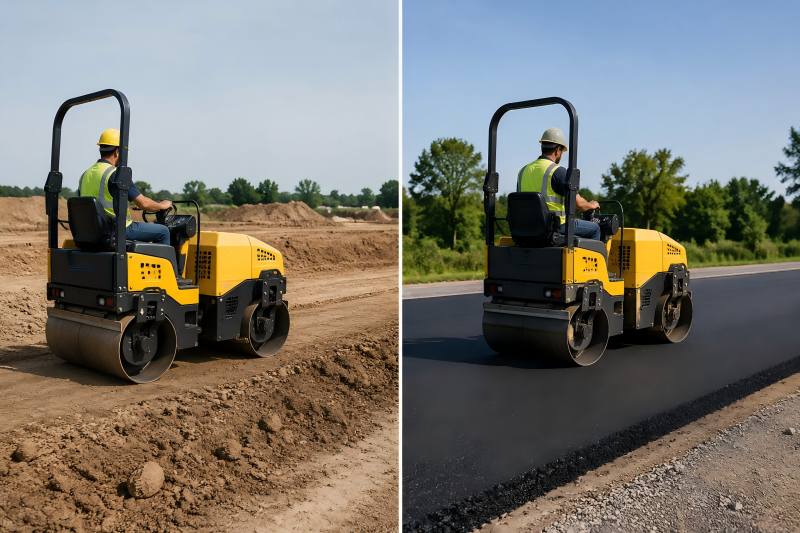
Soil compaction and asphalt compaction are two different processes with different purposes, materials, equipment requirements, and operating methods.
Although both use rollers or compactors to apply pressure and vibration, the principles behind them are not the same. Soil compaction focuses on improving the density and stability of natural or processed soil layers, while asphalt compaction focuses on creating a strong, smooth, and durable pavement surface by controlling the density of hot asphalt mixtures.
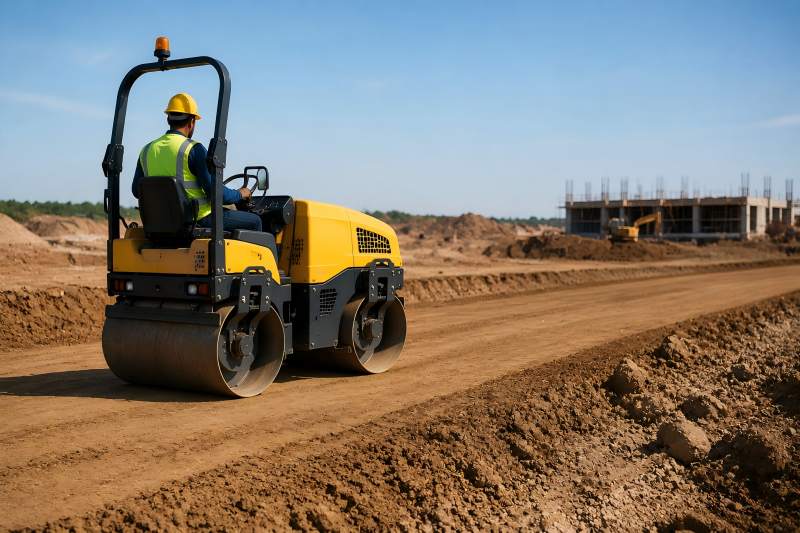
What Is Soil Compaction?
Soil compaction reduces soil voids and increases stability through mechanical compression. During construction, loose soil usually contains many voids, which can lead to uneven settlement, reduced strength, and structural problems.
Compaction equipment applies pressure, vibration, or impact force to rearrange soil particles and create a more stable foundation.
Soil compaction is commonly used for:
- Road subgrades
- Building foundations
- Embankments
- Airport runways
- Pipeline construction
- Parking areas
- Landscaping projects
The main goal is to create a stable base that can support the loads above it.
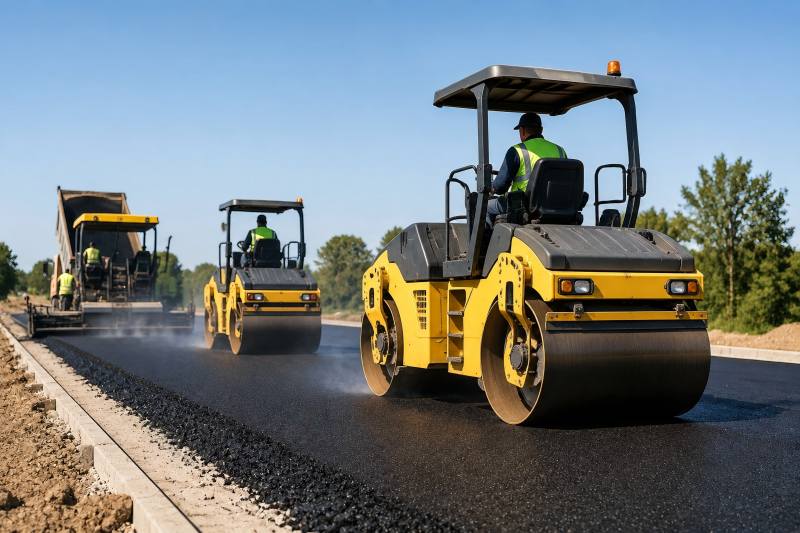
What Is Asphalt Compaction?
Asphalt compaction is the process of compressing freshly laid asphalt pavement while it is still hot and workable. Unlike soil, asphalt is a mixture of aggregates, binder, and additives. The compaction process controls the final density, strength, smoothness, and durability of the pavement.
Proper asphalt compaction helps:
- Reduce air voids inside the asphalt mixture
- Improve resistance to water penetration
- Increase pavement strength
- Prevent cracking and deformation
- Extend pavement service life
Because asphalt temperature changes quickly after placement, timing is a critical factor. Compaction must usually be completed within a specific temperature range before the material becomes too stiff.
Soil vs Asphalt: Compaction Process Differences
Although both processes aim to increase material density, their construction requirements are significantly different.
| Feature | Soil Compaction | Asphalt Compaction |
| Main Material | Natural soil, gravel, sand, clay mixtures | Asphalt concrete mixture |
| Main Purpose | Improve foundation strength and stability | Improve pavement density and durability |
| Compaction Timing | Can be performed after soil placement with moisture control | Must be completed while asphalt remains hot |
| Main Concern | Soil density and bearing capacity | Asphalt density, smoothness, and surface quality |
| Common Equipment | Soil rollers, rammers, plate compactors | Asphalt rollers, tandem rollers, pneumatic rollers |
| Key Parameters | Moisture content, soil type, compaction depth | Temperature, rolling pattern, asphalt density |
| Typical Location | Subgrade and base layers | Road surface and pavement layers |
Difference in Materials
The biggest difference between soil and asphalt compaction comes from the materials being processed.
Soil Compaction Materials
Soil is a natural material consisting of different proportions of:
- Sand
- Clay
- Silt
- Gravel
- Rock particles
Each soil type reacts differently during compaction.
For example:
- Sandy soil usually compacts well through vibration because particles can rearrange easily.
- Clay soil requires moisture control and slower compression because it has stronger cohesion.
- Mixed soils require careful equipment selection based on particle size distribution.
The objective is mainly to reduce air voids and increase soil strength.
Asphalt Compaction Materials
Asphalt is an engineered mixture containing:
- Aggregates
- Mineral fillers
- Asphalt binder
Temperature has a major impact on asphalt behavior. When asphalt is hot, it becomes flexible and can be compressed. As it cools, it becomes harder and more stable.
Therefore, asphalt compaction requires not only the correct equipment but also proper timing.
How Compaction Goals Differ
Each process has its own specific compaction goals.
Soil Compaction Goal
The primary purpose of soil compaction is to create a strong supporting layer.
A properly compacted soil layer provides:
- Higher load-bearing capacity
- Reduced settlement
- Improved foundation stability
- Better resistance against deformation
For example, before constructing a highway, the soil underneath must be compacted to prevent future road sinking.
Asphalt Compaction Goal
The main purpose of asphalt compaction is to improve pavement performance.
Proper asphalt compaction provides:
- Correct pavement density
- Smooth driving surface
- Better resistance to traffic loads
- Lower water penetration
- Longer pavement lifespan
Insufficient asphalt compaction can result in cracks, potholes, and early pavement failure.
Difference in Equipment Selection
Different materials require different compaction machines. Common soil compaction equipment includes:
Vibratory Rollers
Suitable for granular materials including:
- Sand
- Gravel
- Crushed stone
The vibration helps particles move closer together.
Padfoot Rollers
Suitable for:
- Clay
- Cohesive soil
- Heavy earthwork applications
The drum surface creates deeper pressure into the soil layer.
Plate Compactors and Rammers
Commonly used for:
- Small construction areas
- Trench work
- Repair projects
Equipment for Asphalt Compaction
Asphalt normally uses specialized rollers:
Tandem Rollers
Used for:
- Asphalt finishing
- Surface smoothing
- Final compaction passes
Pneumatic Tire Rollers
Use rubber tires to apply flexible pressure, helping improve asphalt density.
Vibratory Asphalt Rollers
Combine vibration and rolling force to achieve higher density efficiently.
Soil Compactor vs Asphalt Roller: Equipment Comparison
| Equipment Type | Best Application | Main Advantage |
| Plate Compactor | Small soil areas, paving blocks, trenches | Flexible operation in limited spaces |
| Rammer Compactor | Clay soil and narrow areas | Strong impact force |
| Padfoot Roller | Heavy soil compaction | Effective for cohesive soil |
| Vibratory Soil Roller | Gravel and granular soil | High compaction efficiency |
| Tandem Asphalt Roller | Asphalt finishing | Smooth surface quality |
| Pneumatic Roller | Asphalt density improvement | Uniform pressure distribution |
Difference in Operating Methods: Soil Compaction Process
A typical soil compaction process includes:
1. Soil Preparation
The soil is spread evenly and adjusted to the required moisture level.
2. Equipment Selection
The machine is selected based on:
- Soil type
- Layer thickness
- Project requirements
3. Compaction Passes
Multiple machine passes are carried out to obtain the required soil density.
4. Density Testing
Construction teams usually test the compacted soil to confirm performance.
Asphalt Compaction Process
Asphalt compaction usually follows a more time-sensitive process:
1. Asphalt Placement
Hot asphalt mixture is laid using a paving machine.
2. Initial Rolling
The initial rolling starts while asphalt remains hot and easy to compact.
3. Intermediate Rolling
Additional passes improve density and remove remaining voids.
4. Final Rolling
The final stage improves surface smoothness and appearance.
Unlike soil, delaying asphalt compaction can significantly affect the final quality.
Difference in Important Control Factors
Different factors influence the final results.
| Control Factor | Soil Compaction | Asphalt Compaction |
| Moisture | Critical for achieving maximum density | Less important than temperature |
| Temperature | Usually not a major factor | One of the most important factors |
| Material Type | Determines equipment choice | Determines mixture behavior |
| Rolling Speed | Affects soil density | Affects asphalt surface quality |
| Number of Passes | Depends on soil condition | Depends on asphalt requirements |
Common Problems Caused by Poor Compaction
Problems with Poor Soil Compaction
Insufficient soil compaction may cause:
- Uneven settlement
- Foundation movement
- Road base failure
- Reduced load capacity
- Cracks in structures above
Problems with Poor Asphalt Compaction
Poor asphalt compaction may lead to:
- Premature pavement cracking
- Water damage
- Rutting caused by traffic
- Loose aggregate
- Reduced pavement lifespan
How to Choose the Right Compaction Equipment?
1. Material Type
Compaction techniques differ based on the characteristics and behavior of the material.
- Clay → Padfoot roller or rammer
- Gravel → Vibratory roller
- Asphalt → Asphalt roller
2. Project Scale
Large infrastructure projects usually require heavy rollers, while smaller construction sites may need compact compactors.
3. Required Compaction Depth
Heavy equipment is needed for deeper layers, while lightweight machines are suitable for surface work.
4. Construction Conditions
Factors such as working space, material moisture, and production schedule also influence equipment selection.
Soil compaction and asphalt compaction may appear similar because both involve rollers and mechanical force, but they serve different construction purposes.
Soil compaction focuses on creating a strong and stable foundation by improving soil density, while asphalt compaction focuses on achieving the correct pavement density and surface performance.
The biggest differences are related to:
- Material characteristics
- Compaction objectives
- Equipment selection
- Operating methods
- Control factors
Selecting the right compaction equipment based on material type and project requirements is essential for improving construction quality, reducing maintenance costs, and extending service life. For contractors, choosing the right compaction method ensures durable and high-quality construction results.