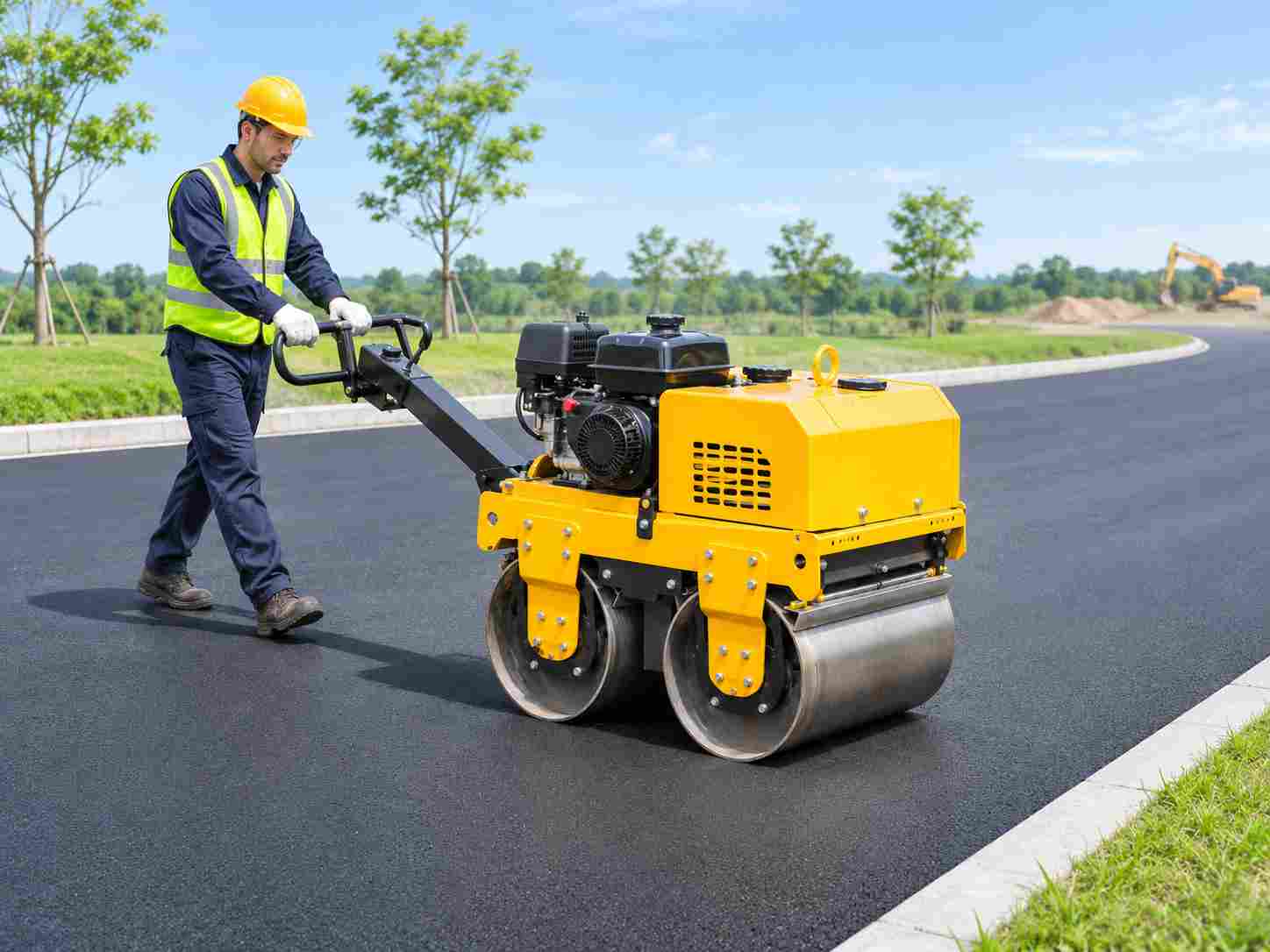
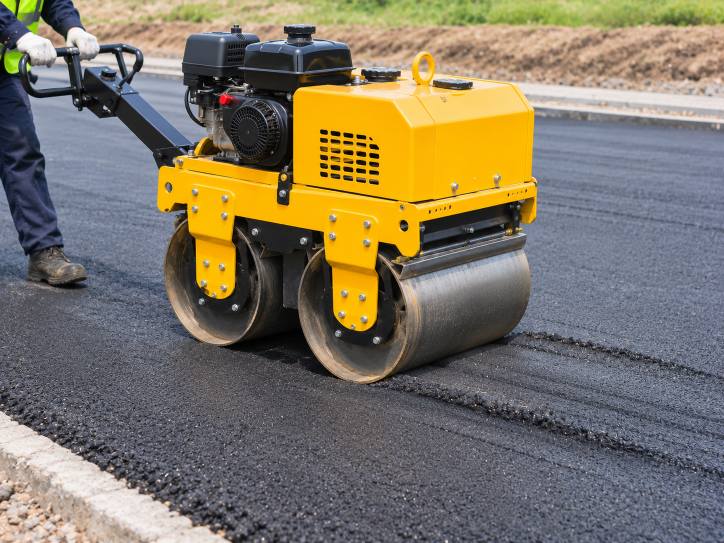
A tandem roller leaves ridges where it stops or reverses on asphalt because the steel drums apply concentrated pressure to a hot, relatively soft mixture while the machine changes speed or direction. This can cause asphalt to move horizontally, creating raised ridges, shallow depressions, or uneven surface marks. Common causes include abrupt braking, sudden reversing, prolonged stationary contact, excessive asphalt temperature, and incorrect vibration settings.
Understanding how asphalt responds during braking, stopping, and restarting helps operators prevent surface defects and achieve more consistent compaction.
Why Does Asphalt Deform When a Roller Stops?
Hot-mix asphalt (HMA) consists of three primary components: aggregates, mineral filler, and asphalt binder, which combine to form a durable paving material. At high temperatures, the binder becomes softer, allowing aggregate particles to rearrange under compaction pressure.
During normal rolling, the tandem roller distributes pressure progressively across the pavement. However, when the machine slows down or stops, the loading conditions change.
Three factors contribute to surface deformation:
- Concentrated pressure: The drum applies its operating weight to a limited area for longer.
- Horizontal shear: Changes in drum movement can push unstable asphalt forward or sideways.
- Static indentation: A stationary drum may sink slightly into a soft asphalt mat.
These effects can create visible ridges around the drum contact area, particularly when the mixture is still very hot.
Why Does Braking Create Asphalt Ridges?
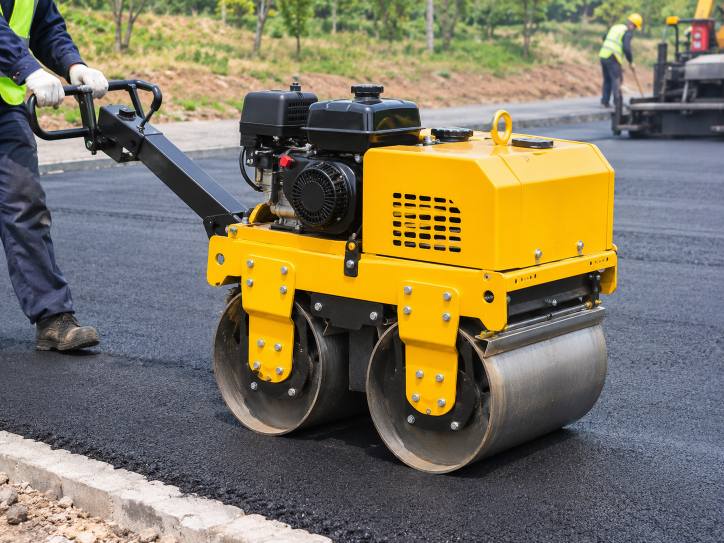
When a tandem roller decelerates, its drum continues applying pressure while forward movement decreases. If the asphalt mixture cannot resist the resulting forces, aggregate particles and binder can shift horizontally.
This movement is known as shear deformation.
Several conditions make the problem worse:
Abrupt Braking
Sudden braking creates a rapid change in the relationship between drum rotation and machine travel. On tender asphalt, this can push material ahead of the drum and produce raised ridges.
Increased Contact Time
As travel speed decreases, the drum spends more time loading each section of pavement. This can increase local indentation, especially when the asphalt has insufficient stability.
Excessive Asphalt Temperature
Hotter mixtures generally have lower resistance to deformation. If compaction takes place at an unsuitable temperature, even normal roller pressure may cause shoving or surface waves.
Why Does Reversing Direction Leave Ridges?
Reversing involves three distinct stages, each of which can affect surface quality.
| Operating stage | What happens | Potential defect |
| Before stopping | Roller decelerates while maintaining drum contact | Horizontal shoving |
| At zero speed | Drum weight remains concentrated on one location | Static indentation |
| First movement after reversing | Roller accelerates in the opposite direction | Surface displacement or ridges |
The first drum length after reversing deserves particular attention.
If the operator accelerates suddenly, the drum may disturb the asphalt before reaching a stable travel speed. If vibration remains active during this transition, repeated dynamic loading can further deform the mixture.
For this reason, operators should disengage vibration before stopping and follow the manufacturer’s recommended procedure when restarting in the opposite direction.
Main Factors That Cause Stop-and-Reverse Ridges
Different operating and material conditions can contribute to the same surface defect.
| Factor | Effect on asphalt | Typical result |
| Abrupt braking | Increases horizontal shear | Raised ridges |
| Long stationary stops | Concentrates drum pressure | Indentations |
| Excessive mix temperature | Reduces mixture stability | Shoving and waves |
| Tender asphalt mixture | Cannot resist loading effectively | Surface displacement |
| Incorrect vibration operation | Creates unsuitable dynamic loading | Drum marks |
| Inconsistent travel speed | Changes impact spacing | Uneven compaction |
| Repeated reversal points | Concentrates deformation | Localized bumps |
If ridges appear repeatedly despite consistent operating techniques, the asphalt mixture and underlying support should also be investigated.
How to Prevent Ridges During Roller Operation
Preventing surface defects requires controlled machine movement and a consistent rolling pattern.
Reduce Speed Gradually
Avoid sudden braking when approaching the end of a rolling pass. Reduce speed smoothly to minimize horizontal forces on the asphalt.
Acceleration should also be gradual when changing direction.
Avoid Stopping on Fresh Asphalt
Keep the roller moving whenever practical. If an interruption is necessary, move the machine away from the freshly laid mat to avoid prolonged static loading.
Disengage Vibration Before Stopping
Vibration generates repeated dynamic forces through the eccentric mechanism inside the drum. When the machine is stationary, these forces become concentrated in one area.
Operators should switch off vibration before stopping, following the equipment manufacturer’s instructions.
Maintain Consistent Rolling Speed
A stable travel speed helps maintain uniform impact spacing and compaction quality.
For vibratory rollers, travel speed and vibration frequency jointly determine how many vibration impacts are applied per unit of travel distance.
Distribute Reversal Points
Avoid reversing at exactly the same location during every pass.
Where site conditions permit, stagger reversal points and use overlapping rolling patterns to prevent repeated deformation in one area.
Recommended Operating Practices
The following table summarizes practical measures for reducing roller marks.
| Rolling operation | Recommended practice | Objective |
| Approaching the stopping point | Gradually reduce speed | Minimize shear |
| Before stopping | Disengage vibration as required | Prevent concentrated dynamic loading |
| During a stop | Avoid prolonged stationary contact | Reduce indentation |
| Reversing direction | Accelerate smoothly | Minimize surface displacement |
| During compaction | Maintain consistent speed | Improve uniformity |
| Between passes | Stagger reversal locations | Reduce localized ridges |
| Finish rolling | Use appropriate static rolling | Improve surface smoothness |
Operating parameters should always follow project specifications and the roller manufacturer’s recommendations.
How to Identify the Source of Asphalt Ridges
Not all ridges indicate equipment problems. Some originate from asphalt mixture instability or inadequate underlying support.
Equipment-related causes
Check whether:
- Braking and reversing are too aggressive.
- Vibration remains active while stationary.
- Travel speed changes significantly between passes.
- Reversal points consistently occur in the same locations.
- Drum scrapers and vibration systems are functioning correctly.
Mixture-related causes
Investigate whether the asphalt is excessively hot, has insufficient internal stability, or contains unsuitable aggregate and binder characteristics.
A tender mixture may deform under both static and vibratory rolling.
Density-related problems
Surface appearance alone cannot confirm compaction quality. Field density measurements, core samples, or other approved testing methods are necessary to evaluate whether the required density has been achieved.
Can Additional Rolling Remove Existing Ridges?
Additional rolling may reduce minor surface irregularities if the asphalt remains workable and the mixture is stable.
However, excessive rolling can make the problem worse by causing further aggregate displacement or uneven density.
| Surface condition | Recommended response |
| Minor shallow drum marks | Consider controlled finish rolling |
| Raised ridges or shoving | Investigate mixture stability |
| Deep drum indentations | Evaluate surface profile and corrective requirements |
| Repeated washboard marks | Check vibration settings and travel speed |
| Uneven density | Verify through field testing |
Once asphalt cools significantly, conventional rolling becomes less effective at correcting surface deformation. Any corrective work should follow project specifications and engineering requirements.
A tandem roller leaves ridges when stopping or reversing because changes in machine speed, drum pressure, and horizontal shear can deform hot asphalt. The problem is particularly common when braking is abrupt, stationary contact is prolonged, or vibration is used incorrectly.
To prevent these defects, operators should maintain consistent travel speeds, disengage vibration before stopping, accelerate smoothly when reversing, and distribute reversal points across the pavement.
Equally important is controlling asphalt temperature and ensuring adequate mixture stability. Combining proper roller operation with density testing helps achieve a smoother surface, more uniform compaction, and better long-term pavement performance.