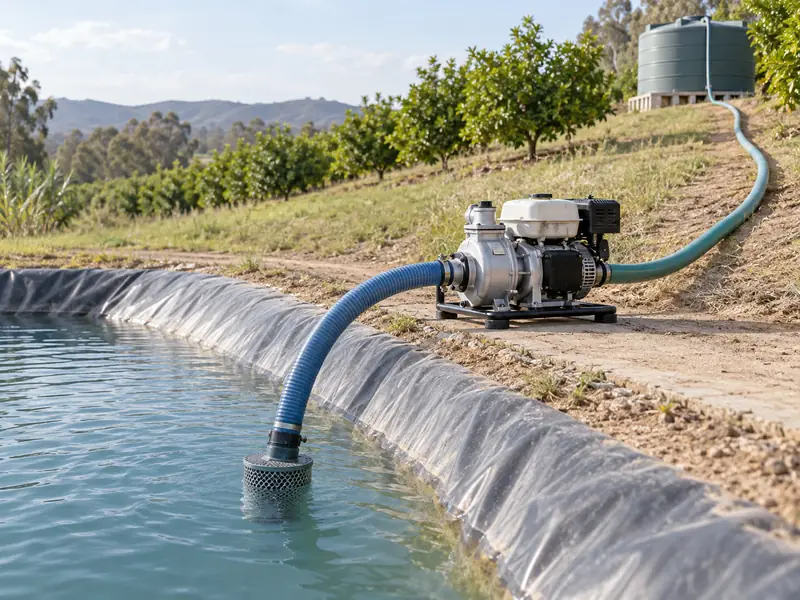
A self-priming centrifugal water pump uses water retained in its casing to help remove air from the suction path and establish a continuous liquid flow. Self-priming describes that air-clearing capability; it does not mean the pump can safely start with an empty casing. The required fill level and starting procedure depend on the particular machine.
This distinction can seem surprising when the word “self” suggests a completely automatic process. In practice, the pump’s internal geometry does part of the work after the operator has prepared it correctly. Understanding the sequence makes its behavior at startup much easier to interpret.
What Does Priming Actually Achieve?
Priming establishes the liquid conditions that a centrifugal pump needs to move water effectively. If its working spaces contain mostly air, the rotating impeller cannot develop the same useful pressure difference it develops with water. Hearing the engine run steadily tells the operator nothing definite about liquid delivery; the outlet may still remain dry because the hydraulic path has not formed.
The pump transfers energy to liquid through a rotating impeller and a surrounding stationary casing. In normal operation, water enters near the impeller’s center and moves through the pump to the discharge. A supply of liquid must replace what leaves if delivery is to continue.
The Hydraulic Institute’s discussion of priming and unexpectedly low pump pressure explains why liquid availability at startup matters. The term “running” can describe the engine without proving that the hydraulic side has established flow. Those two events should be understood separately.
How Does the Pump Clear Air From the Suction Hose?
In a common water-retaining self-priming design, liquid circulates within the casing while air is drawn from the suction path. The internal arrangement allows air to separate and leave through the discharge side, while enough liquid remains available to continue the process. As air is removed, water rises through the suction hose toward the pump.
This is a general explanation of a common centrifugal design, not a sectional drawing of every self-priming pump. Some machines use different arrangements or additional priming equipment. The word on the label therefore does not identify every internal component or startup requirement.
- The prepared casing contains the liquid needed for the priming cycle.
- The impeller starts moving that liquid and the air entering from the suction path.
- The pump’s internal passages allow air to leave while liquid continues circulating.
- Water reaches the inlet and replaces the air that occupied the suction line.
- The pump transitions into continuous water delivery when the liquid path is established.
Notice that this sequence needs somewhere for displaced air to go. An unsuitable closed or obstructed discharge arrangement can interfere with startup. Use the valve positions and hose arrangement stated in the operating instructions rather than improvising a universal priming shortcut.
Is the Pump Pulling Water Up Like a Rope?
No: reducing pressure inside the suction path allows the higher pressure acting on the source water to move it toward the pump. In an open reservoir, atmospheric pressure provides that outside pressure. The available pressure difference has limits, so a pump cannot lift water from any depth simply by running faster.
The practical limit also depends on inlet losses and the conditions needed to avoid vapor formation inside the pump. Source temperature and site elevation can matter. A large discharge-head number must not be interpreted as an equally large suction-lift capability.
Why Must Water Be Added Before the First Start?
An empty water-retaining casing cannot perform its intended air-and-water circulation cycle. Filling it supplies the working liquid needed to begin that process. This is why the instruction to prime the pump is compatible with a self-priming product description.
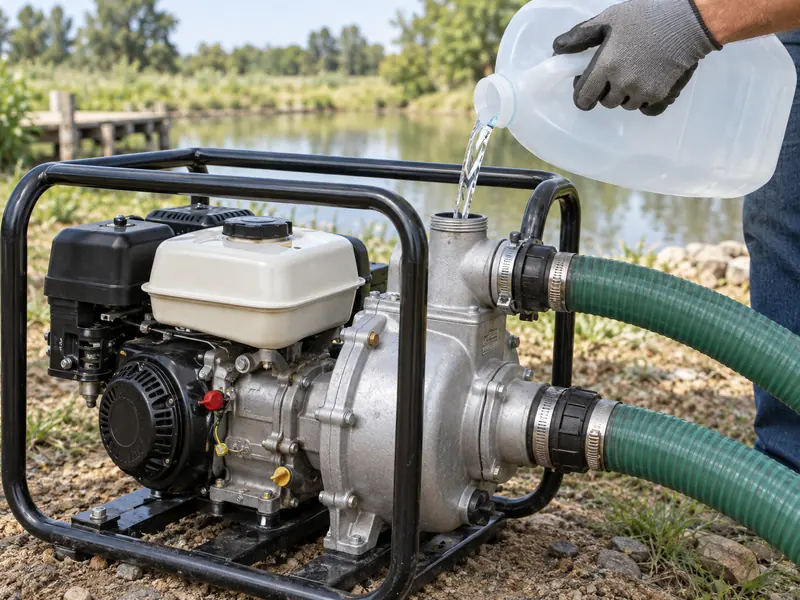
Use the designated priming opening and the liquid specified by the manufacturer, with the machine stopped and prepared according to its manual. Do not confuse the pump opening with the engine’s fuel or oil filler. Replace the cap and sealing components as instructed before operation.
Excalibur identifies its diesel clear water pumps as self-priming centrifugal pumps. That identifies the general pumping category, while the supplied unit’s instructions determine how its casing is filled and how long the priming attempt may continue. The engine’s starting system does not remove this hydraulic preparation.
Why Is Self-Priming Different From Dry-Running Capability?
During an intended priming cycle, the casing contains water even though the suction hose may initially contain air. Dry running is a different condition in which required liquid is absent from working areas. Components that depend on liquid for cooling or lubrication can then be damaged.
Do not use the absence of immediate leakage or unusual noise as evidence that dry running is acceptable. Damage may occur before an obvious external symptom appears. A self-priming label should never be treated as permission to leave an empty pump operating indefinitely.
| Condition | What It Means |
| Prepared priming cycle | The casing contains required liquid while the pump removes air from the suction path |
| Normal delivery | A continuous liquid supply passes through the pump |
| Air entering during operation | The established liquid path is being interrupted |
| Empty casing | The required starting condition for this design is missing |
| Drained storage | The pump may need filling again before its next use |
What Determines How Quickly a Pump Primes?
The amount of air to clear and the height water must rise both affect the startup task. A longer suction hose generally contains more air than a shorter hose of the same diameter. Raising the pump farther above the source also makes the inlet arrangement more demanding.
Hose routing and connections matter because the suction side operates below surrounding pressure during lift. A small opening can admit air without producing an obvious outward water leak. The pump may then keep receiving air instead of completing a stable liquid path.
For a hypothetical irrigation setup, moving a pump from a high bank to a stable lower platform could reduce suction lift. Shortening an unnecessarily long inlet hose would also reduce the air volume to remove. This illustrates the direction of the changes; it does not predict a priming time for a particular model.
Why Should the Inlet Remain Submerged?
If the water level falls far enough, the inlet can draw air directly or through a surface vortex. A pump that previously primed successfully may then lose stable delivery. Maintaining suitable submergence is part of sustaining the liquid supply, not merely a startup detail.
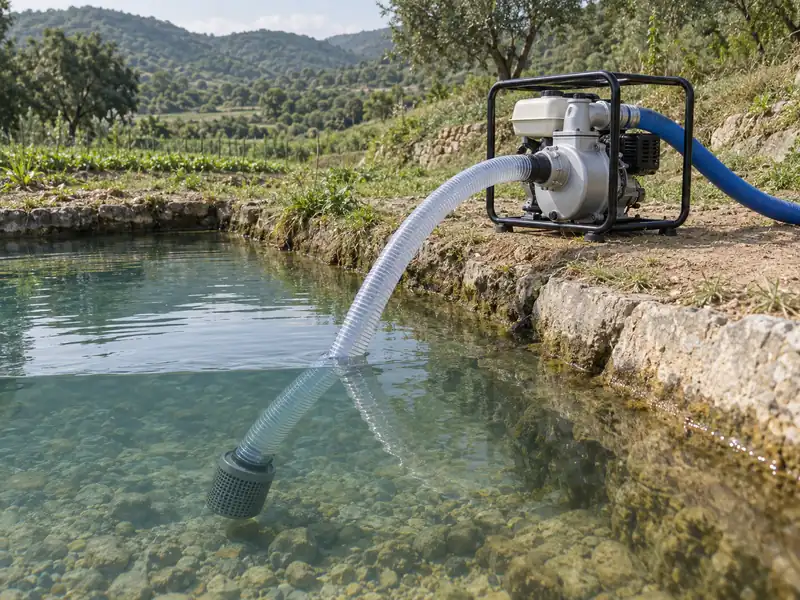
The Hydraulic Institute’s guidance on pump piping and inlet vortices describes how air entering at the source can degrade performance. Keep the appropriate strainer clear of the bottom and use the specified inlet arrangement. Submergence must be sufficient for the installation rather than guessed from a barely covered strainer.
Will a Self-Priming Pump Restart Without Adding Water Again?
It may, if the design retains the necessary liquid and the installation remains suitable. That is a conditional capability, not a promise that every restart needs no attention. Draining, leakage, transport, or changes to the hoses can alter the starting condition.
A compatible foot valve can reduce reverse drainage from the suction line in some installations. It does not eliminate the initial casing-fill requirement or make an unsuitable suction layout work. Follow the manufacturer’s guidance because valves also add resistance and require compatibility with the pumped water.
After storage or servicing, treat the pump according to the specified startup procedure. If freezing conditions require draining, refilling before later operation becomes particularly important. Protecting the casing during storage and preparing it for pumping are different stages of use.
Does the Engine Fuel Change the Meaning of Self-Priming?
Gasoline and diesel describe the power source, while self-priming describes a hydraulic function. Either engine type can drive an appropriately designed centrifugal pump. The fuel label by itself does not establish whether a casing retains water or what startup preparation is necessary.
Excalibur’s gasoline water pumps offer another engine-driven product family. Our discussion of water pump types and applications gives broader context. Keep the engine and pump functions separate when interpreting their descriptions.
How Does Priming Relate to Flow and Head After Startup?
Successful priming establishes the liquid path; it does not guarantee any particular delivery rate. Once flow is established, the operating point depends on the pump and the connected system. A long restrictive discharge hose can still limit useful delivery even when the suction side is functioning properly.
Our explanation of water pump head and flow rate develops that separate relationship. Water quality and the application’s other requirements also remain relevant, as discussed in our water pump application guide. Priming is one necessary operating condition rather than the whole description of pump performance.
The simplest mental model is that the operator supplies the initial casing water and the self-priming design manages the remaining air-clearing process within its limits. Keeping air removal, liquid retention, and normal delivery distinct resolves much of the confusion around the term. The result is a clearer understanding of what the pump can do automatically and what its operating instructions still require.