Yes, one thermoplastic marking machine can be used for both lane lines and directional arrows, provided it supports the appropriate application methods and interchangeable marking tools.
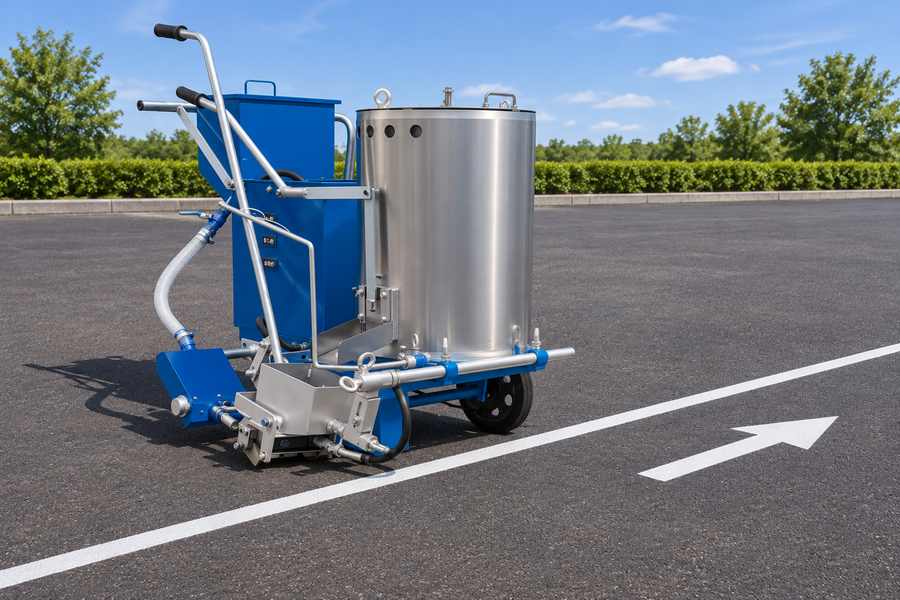
Lane lines are generally produced using a screed shoe or extrusion head, while directional arrows require additional equipment such as stencils, symbol applicators, or suitable spray systems.
For road marking contractors, the key is not simply whether a machine can apply thermoplastic material, but whether its tooling can produce different marking shapes accurately and consistently.
Why Do Lane Lines and Directional Arrows Require Different Applications?
Lane lines and directional arrows use similar thermoplastic materials, but their application requirements differ. Lane lines are typically long, continuous markings with consistent width and thickness. The machine moves along a predetermined path while controlling material flow.
Directional arrows are more complex because they contain multiple geometric sections, including arrowheads, shafts, and sometimes turning indicators. These differences affect the required applicator, operating speed, and material distribution.
| Feature | Lane Lines | Directional Arrows |
| Marking shape | Straight or curved lines | Complex geometric symbols |
| Application method | Screeding or extrusion | Stencils, extrusion, or spraying |
| Material control | Continuous flow | Controlled shape application |
| Movement | Continuous forward movement | More controlled positioning |
| Main requirement | Uniform width and thickness | Accurate dimensions and sharp edges |
A standard line-marking shoe is designed primarily for continuous markings. It cannot automatically produce a complete directional arrow without an appropriate shape-forming attachment or alternative application method.
Which Application Methods Can Handle Both Marking Types?
Thermoplastic marking machines commonly use three application methods: screeding, extrusion, and spraying. The shape on the drawing helps determine which applicator to fit.
Screed Application
Screed systems distribute molten thermoplastic through a shaped metal shoe. Typical work for this setup includes the following markings. Longitudinal stripes separating adjacent lanes.
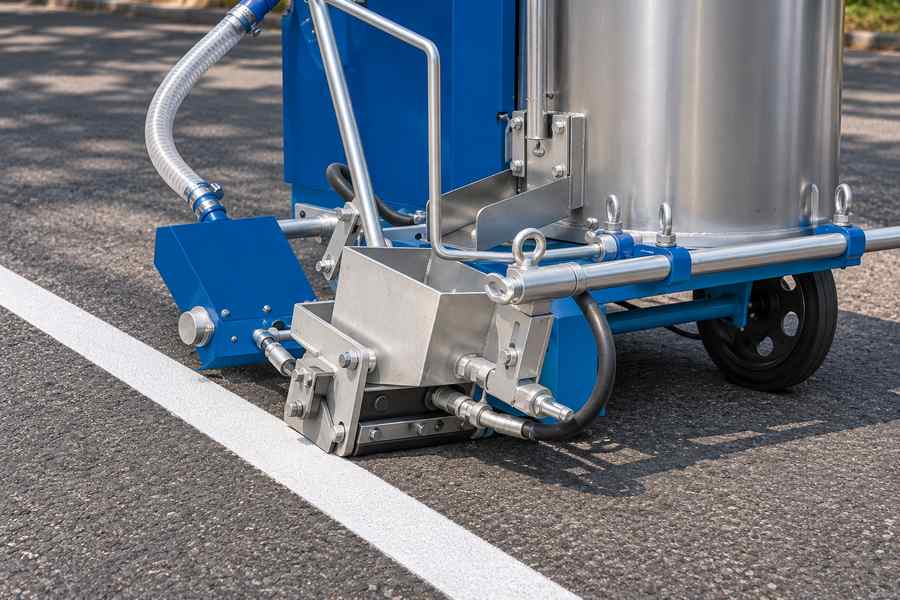
Road edge lines. Stop lines. Continuous parking markings.
For directional arrows, a standard straight-line screed shoe is insufficient. A compatible stencil or separate symbol application setup is required.
Extrusion Application
Extrusion systems force molten thermoplastic through a specially designed applicator. They can produce consistent marking thickness and defined shapes when the correct die or tooling is installed. Depending on the machine configuration, extrusion equipment can support more complex markings, including symbols and certain directional patterns.
Spray Application
Spray systems distribute molten material through controlled spraying equipment. They can be useful for more complex marking patterns, smaller symbols, and applications where conventional line shoes are less practical.
| Application Method | Lane Lines | Directional Arrows | Main Advantage |
| Screeding | Excellent | Requires additional tooling | Uniform continuous lines |
| Extrusion | Excellent | Possible with suitable dies | Controlled thickness and shape |
| Spraying | Suitable | Suitable with appropriate setup | Flexible application |
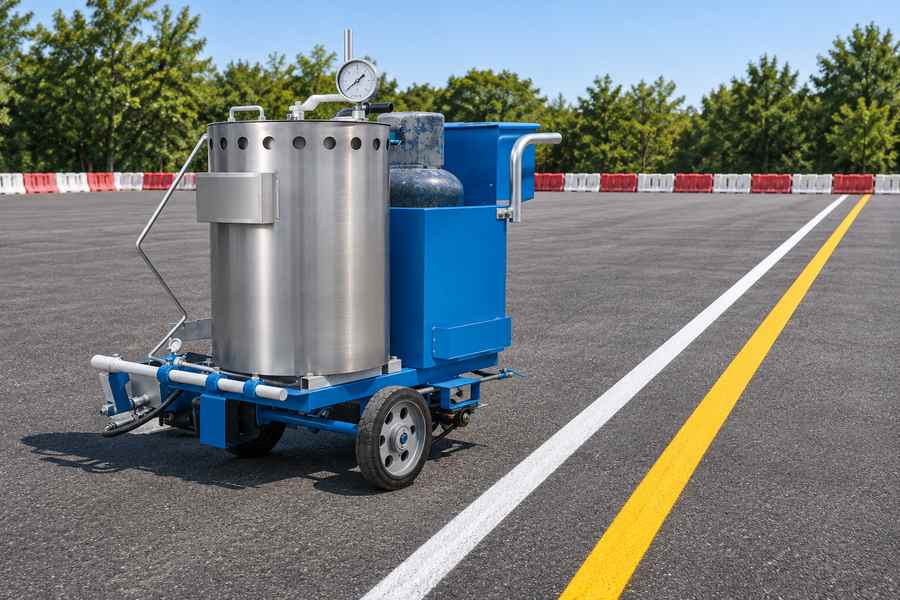
Excalibur’s Thermoplastic Marking Machine product range includes screeding, extrusion, and spraying configurations for different road marking requirements.
What Additional Equipment Is Needed for Directional Arrows?
The most important requirement for applying directional arrows is a suitable shape-control system. Depending on the machine design, contractors may need:
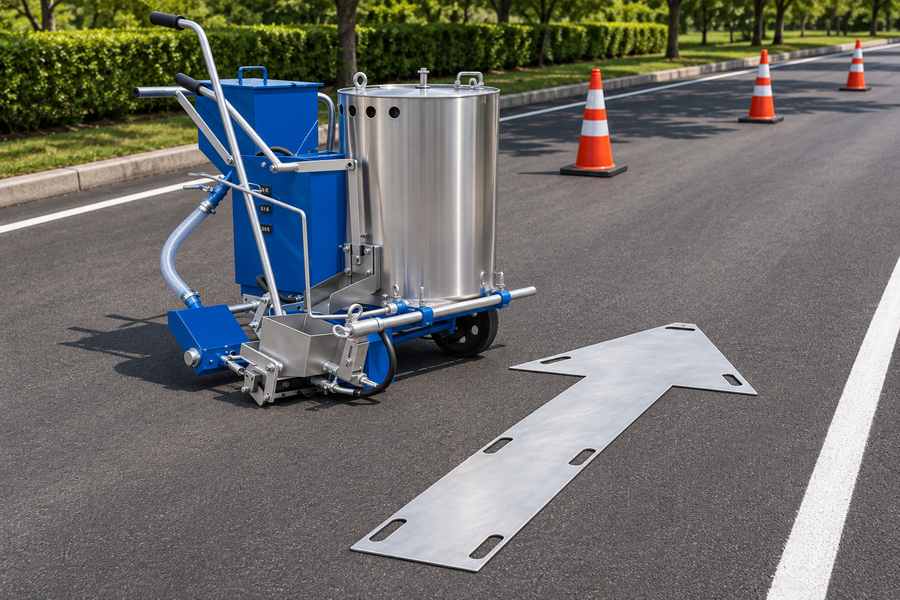
Arrow Stencils
Stencils define the outline of the arrow and help maintain consistent dimensions. A crew can move these units between short runs in a car park or position them for individual arrows at a junction.
Symbol Applicators
Specialized applicators can distribute molten thermoplastic into predefined shapes. They help improve material consistency and reduce manual handling.
Spray Attachments
Spray equipment can be used for certain complex patterns, provided the machine supports the required material flow and application control.
Measuring and Positioning Tools
Chalk lines, templates, measuring tapes, and positioning guides help ensure that arrows are aligned with the intended traffic direction. The correct setup depends on the arrow design, project specifications, and equipment compatibility.
Can the Same Thermoplastic Material Be Used for Lines and Arrows?
In many projects, yes. Both lane lines and directional arrows can use the same type of hot-melt thermoplastic material when their color, performance, and application specifications are identical. Thermoplastic compounds generally contain: Synthetic resins.
Pigments. Mineral fillers. Plasticizers.
Reflective glass beads. However, material selection must follow the project requirements. For example, a white lane line and a white directional arrow may use the same formulation, while a yellow lane marking requires a compatible yellow formulation.
Check the job specification against the applicator setup. The temperature at which the compound must reach the pavement. Required marking thickness.
Color consistency. Glass bead distribution. Pavement adhesion.
Cooling and traffic-opening requirements. Avoid mixing different colors or formulations in the same material system without confirming compatibility and following the manufacturer’s cleaning and changeover procedures.
How to Switch Between Lane Lines and Directional Arrows
Switching between continuous lines and directional arrows requires more than changing the machine’s travel direction. The applicator, positioning method, and material distribution must be adjusted. A practical workflow includes: Complete lane marking: Apply continuous lines using the selected screed or extrusion shoe.
Stop and inspect: Check line width, thickness, and reflectivity. Prepare arrow locations: Measure the required positions and mark reference points. Install the appropriate tooling: Fit the compatible stencil, symbol applicator, or spray attachment.
Apply directional arrows: Control material distribution to achieve the specified shape and thickness. Apply reflective beads: Ensure the beads are distributed while the thermoplastic remains suitable for embedding. Inspect the finished markings: Check dimensions, alignment, color, and retroreflectivity.
The machine should be cleaned and configured according to the manufacturer’s instructions before changing applicators or materials.
What Should Contractors Consider Before Buying One Machine for Both Tasks?
A multifunctional machine can reduce equipment investment, but only when its configuration supports both applications. The following specifications deserve particular attention.
| Selection Factor | What to Check | Why It Matters |
| Application method | Screed, extrusion, or spray | Determines marking capabilities |
| Applicator compatibility | Interchangeable shoes and dies | Allows different marking shapes |
| Marking width | Adjustable working width | Accommodates different line specifications |
| Material capacity | Melting kettle and hopper capacity | Supports continuous operation |
| Temperature control | Heating and temperature regulation | Maintains material consistency |
| Bead dispenser | Adjustable bead distribution | Provides nighttime reflectivity |
| Operating mode | Hand-push or self-propelled | Matches project size |
| Maintenance | Cleaning and attachment replacement | Reduces downtime |
For example, Excalibur’s SHM series includes SHM-300, SHM-310, SHM-320, and SHM-330 configurations. Their published specifications include:
| Specification | SHM Series |
| Kettle capacity | 100 kg |
| Bead box capacity | 10–15 kg |
| Marking width | 100–450 mm |
| Marking thickness | 1.0–3.0 mm |
| Heating method | LPG |
| Operating configuration | Hand-push or powered options, depending on model |
These specifications describe the available machine configurations, not a guarantee that every model includes directional-arrow tooling as standard. Contractors should confirm the required symbol applicator or stencil arrangement before purchasing.
Common Problems When Applying Both Lines and Arrows
Using one machine for different marking tasks introduces several potential operational challenges.
| Common Problem | Possible Cause | Recommended Solution |
| Uneven arrow edges | Incorrect stencil positioning | Secure and align the stencil |
| Inconsistent thickness | Uneven material distribution | Adjust flow and application speed |
| Poor arrow alignment | Incorrect positioning measurements | Use reference lines and templates |
| Uneven reflectivity | Inconsistent bead application | Calibrate the bead dispenser |
| Material contamination | Inadequate cleaning during changeover | Follow the approved cleaning procedure |
| Poor adhesion | Dirty or damp pavement | Prepare the surface before application |
Directional arrows deserve particular attention because even small dimensional or alignment errors can affect their visibility and interpretation by drivers.
How to Improve Efficiency When Marking Lines and Arrows on the Same Project
For contractors handling intersections, parking lots, and urban road projects, organizing the application sequence can reduce unnecessary equipment changes. Consider these practices: Complete long continuous lane lines before moving to individual symbols where the project layout allows. Prepare arrow templates and positioning measurements in advance.
Group markings by color to reduce material changeovers. Assign separate workers to positioning, machine operation, and quality inspection. Check applicator compatibility before arriving at the site.
Keep spare shoes, stencils, and other critical accessories available. For larger projects, a dedicated symbol application system may still be more efficient than repeatedly converting a line-marking machine. One thermoplastic marking machine can handle both lane lines and directional arrows when it supports compatible applicators and shape-forming equipment.
Continuous lines generally require screed or extrusion systems, while directional arrows need additional tooling such as stencils, symbol applicators, or suitable spray equipment. Before purchasing, contractors should verify attachment compatibility, material capacity, temperature control, and marking specifications.
The best solution is a machine configuration that provides consistent line quality while allowing accurate symbol application without unnecessary equipment changes.