When two tamping rammers have the same impact force, stroke length helps explain how their impact mechanisms move and how they may behave during compaction. A longer stroke generally indicates greater movement of the reciprocating mechanism, while a shorter stroke indicates a different operating motion.
However, stroke length alone does not determine compaction performance. To compare two tamping rammers accurately, contractors should consider stroke length alongside impact force, impact frequency, shoe dimensions, machine weight, soil conditions, and operator control.
Understanding these parameters helps buyers select equipment that matches the material and working environment rather than relying on a single specification.
What Is Stroke Length in a Tamping Rammer?
Stroke length describes the travel distance of a reciprocating component within a tamping rammer’s mechanical system. Depending on the manufacturer’s specification, it may refer to piston travel, spring mechanism movement, or another defined mechanical displacement.
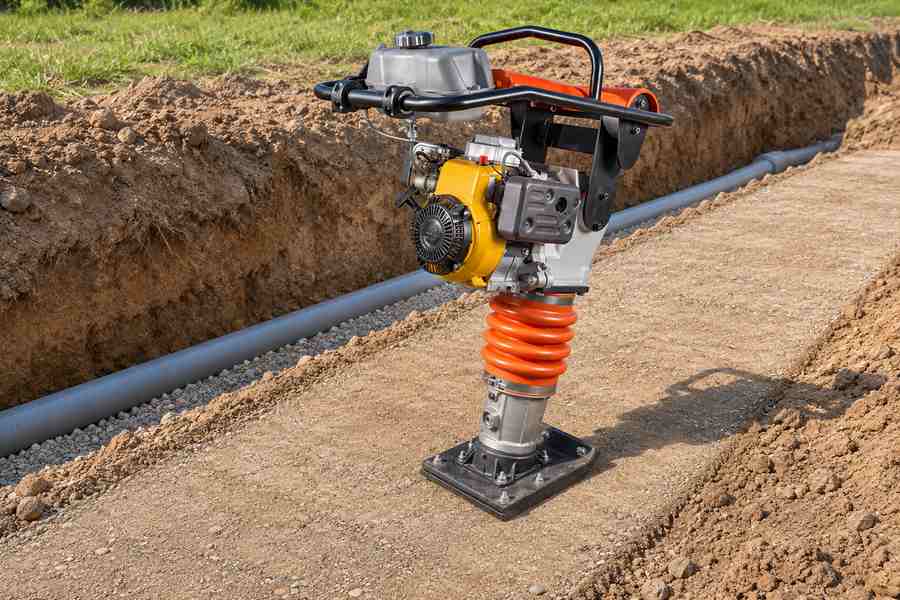
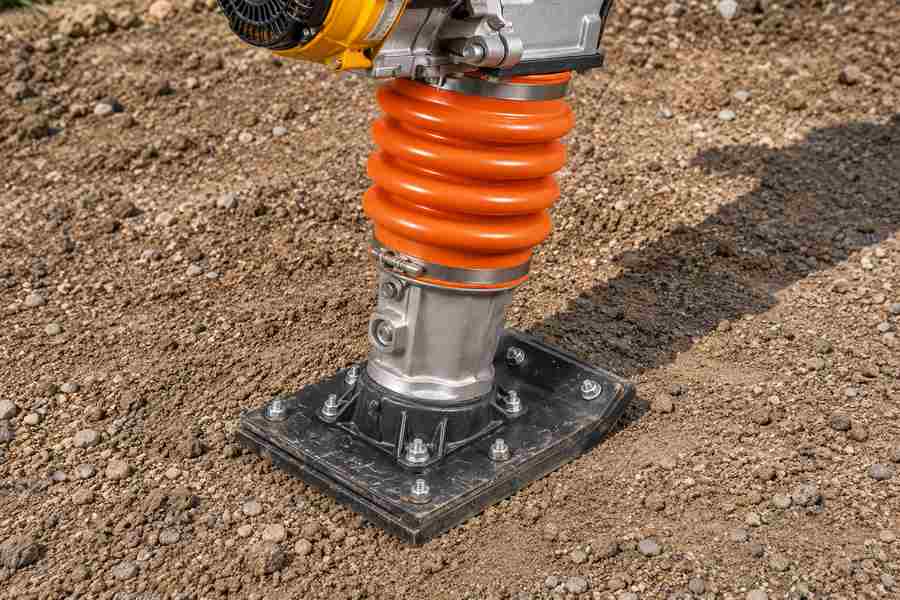
During operation, the engine drives the rammer’s internal mechanism, which transfers energy through the spring assembly to the tamping shoe. The shoe repeatedly lifts and strikes the ground, compacting soil through successive impacts.
A longer mechanical stroke can indicate a greater movement range within the mechanism, but it should not automatically be interpreted as a larger shoe movement or greater delivered compaction energy. This distinction matters because manufacturers may use different definitions and measurement methods.
Buyers should confirm exactly what the published stroke specification represents before comparing machines.
Why Does Stroke Length Matter When Impact Force Is the Same?
Impact force describes the force generated during an impact, while stroke length describes movement within the mechanism. These are different characteristics. Consider two hypothetical tamping rammers with the same nominal impact force but different stroke lengths.
Rammer A: Shorter stroke. Rammer B: Longer stroke. Both machines: Same stated impact force.
Although their nominal impact-force ratings match, their internal movement characteristics may differ. A longer stroke may be associated with a different acceleration profile, spring compression, or mechanical operating cycle. A shorter stroke may produce a different relationship between movement and impact timing.
However, it would be incorrect to assume that the longer-stroke machine always delivers more energy or achieves higher soil density. The shoe, drive system and ground underfoot all affect how the rammer delivers each blow.
Stroke Length, Impact Force, and Impact Frequency: Key Differences
These three specifications describe different aspects of rammer operation.
| Parameter | What It Describes | Why It Matters |
| Stroke length | Defined mechanical travel distance | Indicates movement characteristics |
| Impact force | Force generated during impact | Helps describe impact loading |
| Impact frequency | Number of impacts per unit of time | Influences how frequently soil receives loading |
| Operating weight | Total machine weight | Affects handling and loading |
| Shoe dimensions | Contact area of the tamping foot | Influences pressure distribution |
Impact force and impact frequency should not be confused with total energy delivered to the soil. Similarly, stroke length should not be multiplied directly by peak impact force and treated as actual delivered energy. A valid energy calculation requires the relevant force-displacement relationship throughout the operating cycle.
How Does Stroke Length Influence the Compaction Process?
Stroke length can help engineers understand the movement characteristics of the rammer mechanism, but its practical significance depends on how the entire machine is designed.
Movement of the Internal Mechanism
The reciprocating mechanism converts engine power into repeated mechanical movement. Its travel distance influences the motion profile and interacts with spring characteristics and operating frequency. Two machines with different stroke lengths may therefore behave differently even when their nominal impact-force ratings are identical.
Impact Timing and Operating Stability
Stroke length should be evaluated alongside impact frequency. A machine with a different mechanical travel distance may have a different operating cycle, depending on its mechanism design. The relationship between movement, acceleration, and impact timing affects how consistently the shoe contacts the ground.
Soil Response
Different soil materials respond differently to repeated impacts.
| Soil condition | Important equipment consideration |
| Cohesive clay | Repeated impact action and controlled moisture |
| Silty soil | Moisture sensitivity and uniform compaction |
| Granular soil | Particle rearrangement and suitable impact frequency |
| Mixed backfill | Material consistency and appropriate lift thickness |
| Confined trenches | Shoe dimensions and operator maneuverability |
A longer stroke specification does not guarantee better results in any particular soil category. Field trials and density testing remain essential.
How to Compare Two Tamping Rammers with the Same Impact Force
When two machines share the same nominal impact-force rating, buyers should look beyond the headline specification. The following comparison checklist is useful: Verify stroke definitions: Confirm whether both manufacturers measure the same mechanical movement. Compare impact frequency: Check how many impacts each machine produces per minute.
Review operating weight: Consider how the machine’s weight affects handling and compaction. Check shoe dimensions: Evaluate the contact area and suitability for narrow working spaces. Examine engine performance: Consider engine power, reliability, and fuel consumption.
Evaluate operator control: Check handle vibration, balance, and maneuverability. Request field results: Compare performance under similar soil conditions and lift thicknesses. For a meaningful comparison, both machines should be tested on the same material, at comparable moisture content, using consistent operating procedures.
6. A Practical Comparison: Two Rammers with the Same Impact Force
Excalibur’s SR75 and SR80 provide a useful example of why stroke length deserves attention. Both models have a nominal impact force of 12 kN, but their published jump stroke and impact frequency differ.
| Specification | SR75 | SR80 |
| Impact force | 12 kN | 12 kN |
| Jump stroke | 55–85 mm | 40–65 mm |
| Impact frequency | 640–680 times/min | 600–700 times/min |
| Bottom plate size | 300 × 280 mm | 300 × 280 mm |
| Net weight | 75–80 kg | 80 kg |
The comparison illustrates that identical impact-force ratings do not mean identical operating characteristics. The SR75 has a longer published jump-stroke range, while the SR80 has a different impact-frequency range. These differences may influence operating behavior, but they do not establish which machine delivers better compaction.
For detailed specifications, see the SR75 Tamping Rammer and Excalibur’s Tamping Rammer product range. Important specification note: In this comparison, jump stroke refers to the manufacturer’s published rammer operating specification. It should not automatically be treated as piston stroke or the total displacement of every internal component.
Buyers should confirm the measurement definition with the manufacturer.
How to Evaluate Stroke Length Through Field Testing
When two machines have the same impact force, a controlled field trial provides more useful information than comparing specifications alone. A practical test should include: Prepare two comparable test sections using the same soil material. Maintain similar moisture content and lift thickness.
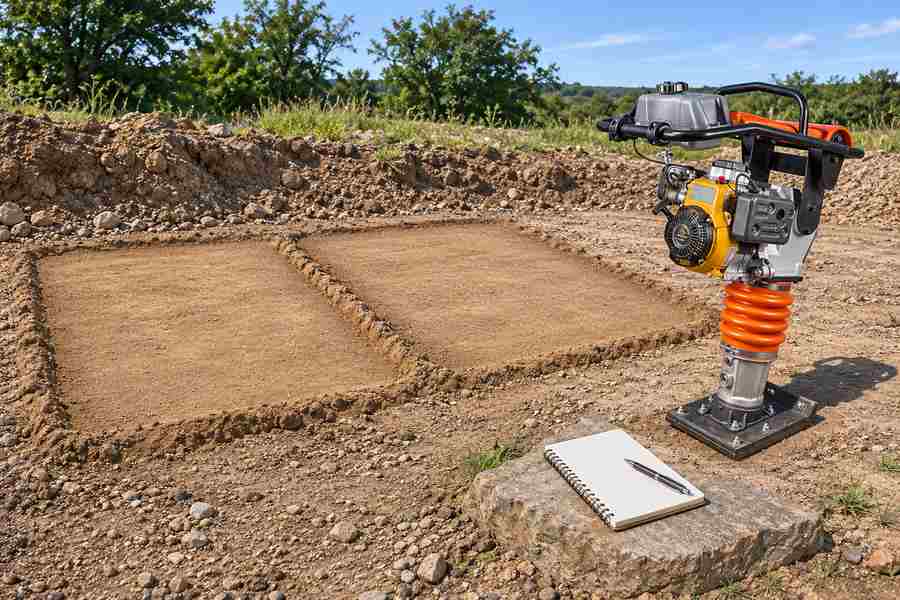
Operate both rammers using the manufacturer’s recommended procedures. Record the number of passes and operating time. Measure the resulting soil density using an approved testing method.
Compare surface uniformity, penetration, handling, and operator fatigue. The following indicators help evaluate the results:
| Test indicator | What to observe |
| Compaction density | Whether the required density is achieved |
| Number of passes | How many passes are needed |
| Operating stability | Whether the machine maintains consistent movement |
| Surface condition | Whether the compacted layer is uniform |
| Operator handling | Ease of control in confined spaces |
| Productivity | Time required to complete the test area |
Testing should use the same acceptance criteria for both machines. Otherwise, differences in soil preparation or moisture can distort the comparison.
8. Choosing a Stroke for the Ground You Need to Compact
Two jobs can favor different amounts of shoe travel. The appropriate specification depends on the machine design, soil characteristics, and project requirements. Consider the following selection factors: Trench compaction: Prioritize machine dimensions, maneuverability, and consistent impact performance.
Cohesive soil: Evaluate impact characteristics alongside moisture content and lift thickness. Mixed backfill: Consider material variability and the ability to achieve uniform density. Frequent operation: Examine machine durability, vibration exposure, and operator comfort.
Different jobsite conditions: Compare complete machine specifications rather than selecting by stroke length alone. When two tamping rammers have the same impact force, stroke length provides another useful way to understand their operating characteristics.
It helps distinguish machines with different movement ranges, but it cannot independently predict compaction depth, energy delivery, or final soil density. For a reliable equipment comparison, evaluate jump stroke together with impact frequency, operating weight, shoe dimensions, engine performance, and field compaction results.
The best tamping rammer is ultimately the machine that achieves the required soil density consistently while offering suitable productivity, durability, and operator control.