Before ordering a diesel generator, confirm its rated output, voltage, frequency, phase arrangement, rated current, power factor and permitted operating duty. Then verify the outlet ratings, starting performance, voltage regulation, protective devices and connection requirements for the loads you actually intend to run. These details should appear together on a signed specification for the exact configuration being supplied. A model name or a headline power figure is not enough to establish electrical compatibility.
This matters particularly when one product family offers several voltages, single-phase and three-phase versions, different control panels and optional starting equipment. Two units with similar housings can deliver different usable outputs. A purchasing team needs a specification that an electrician can check, a factory can build and an inspector can verify. The following sequence turns a general enquiry into a practical electrical purchase requirement.
Start with the equipment, then describe the supply
Prepare a load schedule before comparing generator brochures. Record each appliance or machine, the voltage and frequency shown on its nameplate, its phase requirement, running current and starting characteristics. Mark the appliances that stay on throughout the shift and identify the others that switch themselves on and off. Identify which loads must operate together and which can be started in sequence. An estimate based only on a building’s floor area or the number of sockets leaves important electrical questions unanswered.
A small workshop illustrates the problem. Lighting may stay on throughout the day, while a compressor starts repeatedly and a power tool operates intermittently. Adding the running watts provides useful background, but it does not describe the moment when the compressor starts while the other equipment is already drawing power. The supplier needs both the steady demand and the demanding operating sequence. Otherwise, a generator that appears sufficient on paper may struggle during actual work.
Use the diesel generator range to identify suitable product families, then request a configuration-specific sheet. Treat a catalogue’s list of available voltages as a menu of possible builds unless the manufacturer explicitly confirms that the supplied unit can switch between them. The same principle applies to optional meters, sockets and remote-start equipment.
Give the supplier a defined operating scenario
Your enquiry should describe the expected hours of operation, normal load, highest simultaneous load and largest starting event. Include the ambient temperature and installation altitude if known. Where the site remains undecided, state the intended operating range rather than assuming standard laboratory conditions. Ask the supplier to identify any output reduction or installation restriction that affects the proposal.
Also identify equipment that is unusually sensitive to interruptions or voltage changes. Computers, controls, chargers and variable-speed drives do not all behave alike. Their own input requirements should guide the enquiry. A description such as “suitable for electronics” is too broad to substitute for equipment compatibility information.
Separate rated power from maximum power
Ask the supplier to identify the output available for the intended duty and the conditions under which it is rated. A maximum-output figure should not automatically become the load you expect the machine to carry for a full shift. Where the quotation uses terms such as prime, standby, continuous or rated, request the applicable definition and the permitted operating profile. Do not assume that every supplier uses these labels in the same way.
Keep electrical output separate from engine power. Engine horsepower describes mechanical capability; it is not the same as usable electricity at the outlets. Likewise, the size of the engine or the weight of the machine does not establish its electrical rating. The purchase specification should identify the generator’s output at the agreed voltage, frequency, phase arrangement and site conditions.
Read the two power ratings together
A kW figure expresses real electrical output; a kVA figure accounts for the apparent demand associated with the supply voltage and current. Power factor links these quantities: multiplying the apparent-power value by that factor gives the corresponding real-power value. A hypothetical 10 kVA supply at a load power factor of 0.8 corresponds to 8 kW. This arithmetic is an illustration, not a rating for a particular Excalibur model. The actual set must satisfy both its engine-related real-power limit and its alternator-related current or apparent-power limit.
Ask how the quoted power factor relates to the proposed configuration. A brochure that shows “1/0.8” may be presenting different versions rather than a setting that gives the buyer two interchangeable ratings. Resolve that point before comparing offers. Never apply the most attractive figure from one version to the voltage or phase arrangement of another.
Specify voltage, frequency and phase as one package
Write down the required nominal voltage and whether it is measured between line and neutral or between two lines. This distinction is essential for three-phase equipment. A supply described simply as “400 V” does not tell a buyer whether an appropriate neutral connection is available for lower-voltage single-phase loads. The outlet arrangement and the winding connection must support the intended use.
Frequency also needs an explicit selection. A catalogue entry showing 50/60 Hz may describe separate factory configurations. It does not prove that the operator can switch frequency in service or retain the same output rating after a change. Ask which frequency will appear on the delivered nameplate and which test report supports that configuration. Equipment compatibility should be checked against its own nameplate rather than the destination country alone.
For a mixed installation, list the three-phase loads and the single-phase loads separately. Ask the manufacturer to confirm permissible single-phase loading, phase-current limits and the allowed imbalance. The total three-phase rating cannot simply be assigned to one socket or one phase. If future expansion is expected, describe the planned load arrangement instead of buying an unspecified amount of extra headline capacity.
Check the current available at every connection
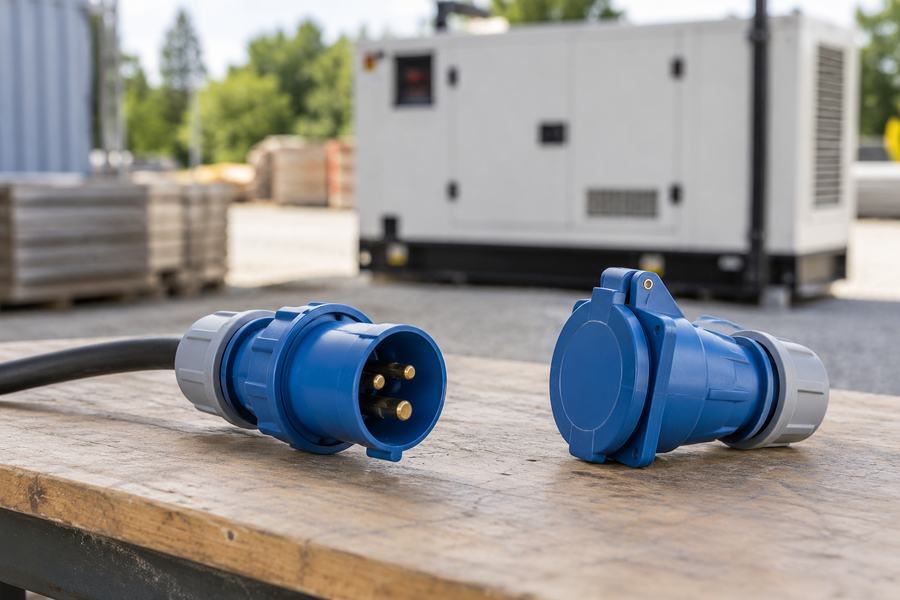
An alternator rating and an outlet rating answer different questions. The generator may have enough total capacity while a particular receptacle, breaker or cable connection limits what can be supplied through that point. Ask for a panel drawing that identifies each outlet’s voltage, current rating, phase connection and associated protective device. Confirm whether several outlets share a breaker or a winding limit.
For a single-phase example, a 230 V load drawing 20 A has an apparent demand of 4.6 kVA. That does not automatically make a generator with a 4.6 kW headline suitable: the load power factor, starting behavior, operating duty and outlet limit still matter. Use calculations to identify questions, then obtain confirmation for the actual machine and distribution arrangement.
Distinguish AC supply from auxiliary DC output
Some portable generator specifications list a small auxiliary DC output alongside the main AC output. These are separate functions. A listed 12 V DC connection does not mean that all the generator’s usable power is available at 12 V, nor does it establish suitability for every battery type. Ask for the permitted purpose, current limit, protection and operating instructions of any auxiliary output you intend to use.
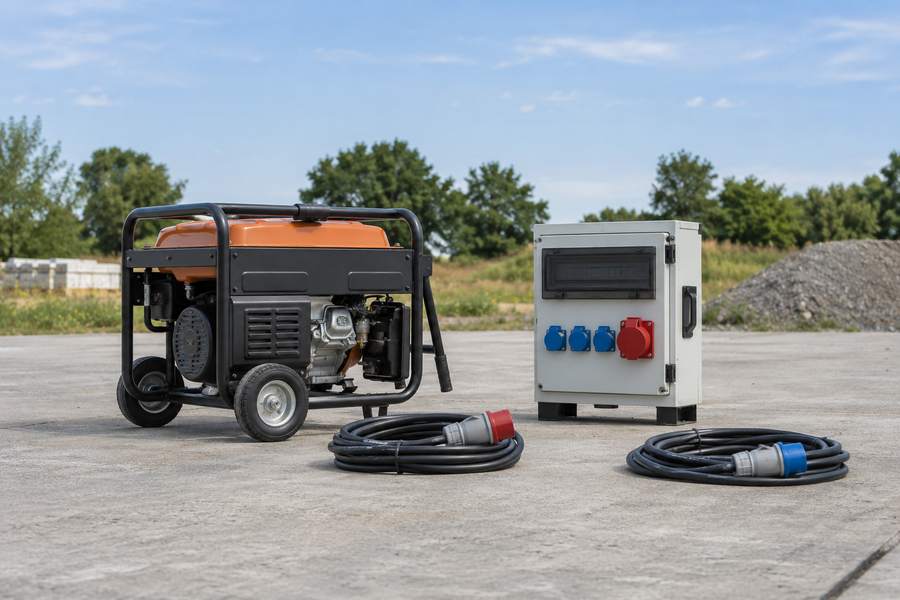
If tools or site distribution boards require a particular plug system, specify it before production. Include the matching connector, enclosure arrangement and required environmental suitability. A photograph of a familiar socket shape is not enough to prove its rating or wiring. The approved panel drawing should correspond to the sockets fitted to the delivered units.
Ask what happens when the load changes
Steady voltage readings describe only part of generator performance. Starting a motor or adding a substantial load can temporarily change voltage and frequency. Ask the supplier to assess your most demanding starting event and provide the relevant performance information. Define which other loads will already be connected, how the new equipment starts and what voltage or frequency disturbance the connected equipment can tolerate.
Avoid prescribing one universal percentage of spare capacity for every application. A resistive heater, a compressor and a group of electronic chargers can impose very different demands even when their running power looks similar. Where the load data is incomplete, identify that uncertainty and request a witnessed trial or a review using the equipment manufacturer’s starting information.
Describe the test, not just the desired result
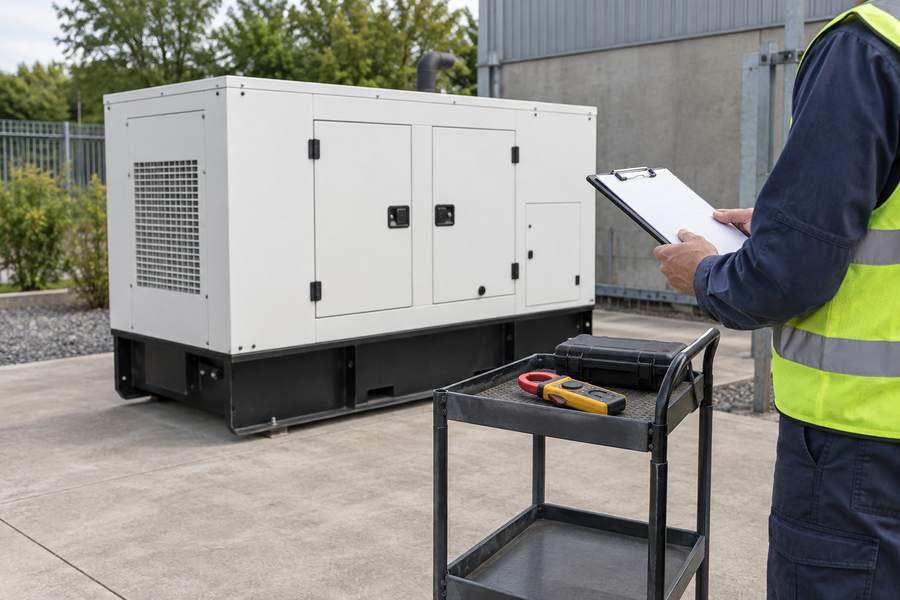
A useful test request states the initial load, the added load, the measurement points and the required recording method. It also identifies the acceptance limits agreed by the supplier and buyer. A photograph of a display showing nominal voltage after the load has settled does not establish how well the generator handled the transition. Transient claims need measurements that can capture the event.
Where a factory cannot test the actual appliance, ask what substitute load will be used and which aspects it represents. A resistive load bank can demonstrate useful output performance but may not reproduce motor starting or nonlinear current demand. The acceptance record should explain which parts of the proposed duty this substitute test demonstrates and which still require confirmation.
Separate voltage regulation from power quality
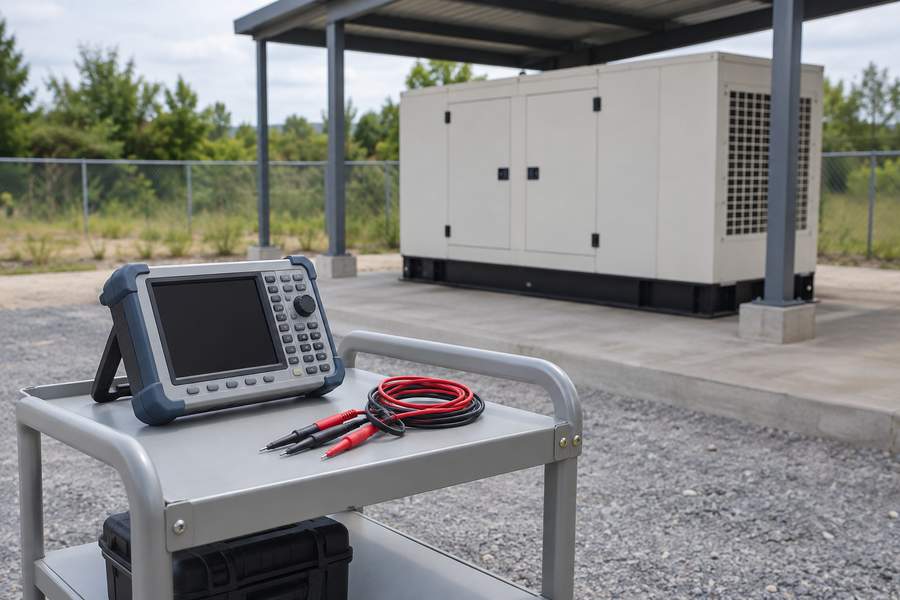
An automatic voltage regulator helps control voltage, but the presence of an AVR alone does not establish every aspect of power quality. Request the regulation figure together with its test load, operating configuration and measurement basis. For sensitive equipment, request appropriate waveform or total harmonic distortion information under a defined load. Do not accept an unsupported claim that an AVR makes any generator suitable for all electronics.
Similarly, a digital meter is a monitoring device unless the supplied system includes documented protective functions. A display can show a voltage or frequency value without automatically disconnecting the load when it becomes unacceptable. Identify which measurements are displayed, which conditions trigger warnings, which cause an electrical trip and which stop the engine.
Put the protection and installation interface in writing
Ask the supplier to list the fitted protective devices and explain their actions. Relevant items may include overload and short-circuit protection, low-oil protection, temperature protection and voltage or frequency supervision. Availability and operation depend on the exact engine, controller and panel. An air-cooled engine should not be described using coolant-specific protection language unless that equipment actually exists.
The site’s qualified electrical installer should review earthing, neutral arrangement, residual-current protection where required, and the connection to any building supply. These decisions depend on the installation and applicable local requirements. Building connections require a properly designed transfer arrangement installed by qualified personnel; feeding generator power backwards through an improvised outlet connection is unsafe. The purchase enquiry should provide the installer with enough information to specify a suitable transfer arrangement and distribution equipment.
If an automatic transfer switch is planned, confirm the generator’s start interface separately from the power connections. Electric starting does not by itself establish automatic-start compatibility. Request the compatible controller, connector information and commissioning procedure. An ATS also does not promise uninterrupted power: starting, stabilization and transfer normally take time unless a separately designed system bridges the interruption.
Build an electrical acceptance schedule
The following schedule is a starting point for a purchase order. Fill in the actual requirements and acceptance limits with the supplier and installer. Blank entries should remain open questions rather than being treated as approval.
| Item | Requirement to record | Evidence to request |
| Rated supply | Voltage, frequency, phases and neutral arrangement | Configuration sheet and nameplate |
| Usable output | Rated kW, kVA where applicable, duty and site conditions | Manufacturer rating statement |
| Connections | Outlet ratings, shared limits and panel layout | Approved drawing and inspection |
| Load response | Starting event and permitted disturbance | Agreed performance test |
| Protection | Device, threshold where applicable and resulting action | Protection schedule and functional test |
| Integration | Earthing information and transfer interface | Wiring documents and installer review |
Add a revision reference to the approved documents. If the panel, alternator or controller changes after sample approval, require written review before shipment. A technically similar substitute can still change outlet availability, starting behavior or the information visible to an operator. Keeping revisions controlled is particularly valuable when several batches will be purchased over time.
Review the exact build before releasing the order
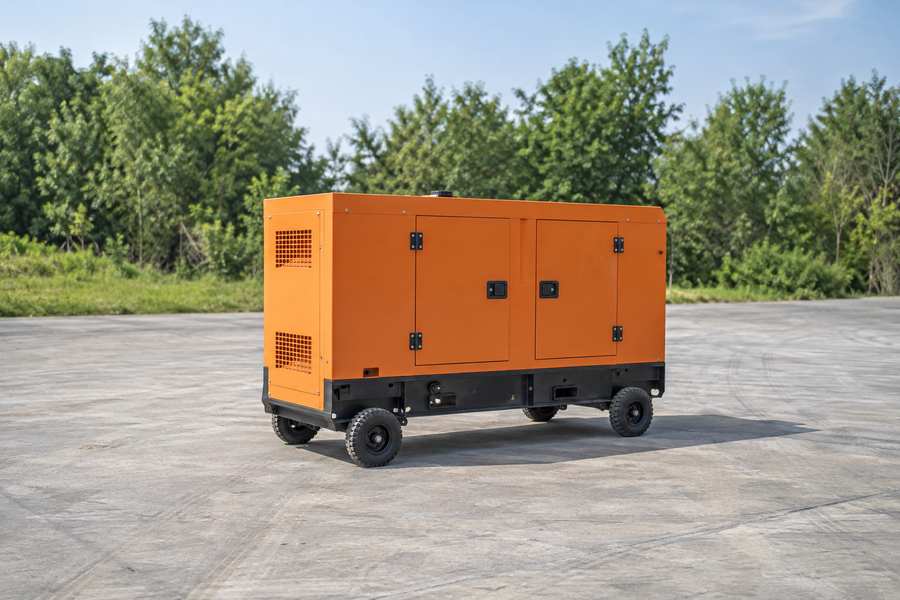
Excalibur’s open diesel generator options include different model and panel choices, so ask for a consolidated sheet covering your selected combination. Do the same when comparing an enclosed version from the silent diesel generator range. The housing style does not remove the need to verify its electrical details.
Before approval, compare the quotation, panel drawing, nameplate proposal and test plan line by line. They should describe the same voltage, frequency, phases, rated output and options. Resolve contradictions in writing, especially when a general catalogue covers several variants. A clear specification gives the factory a build instruction and gives the buyer an objective basis for accepting the delivered generator.
The most useful final question is practical: can the supplier show how this exact unit will serve the stated load schedule through the specified connections? When the answer includes ratings, drawings, operating limits and a suitable test record, the purchase decision rests on usable electrical capability rather than a model name alone.