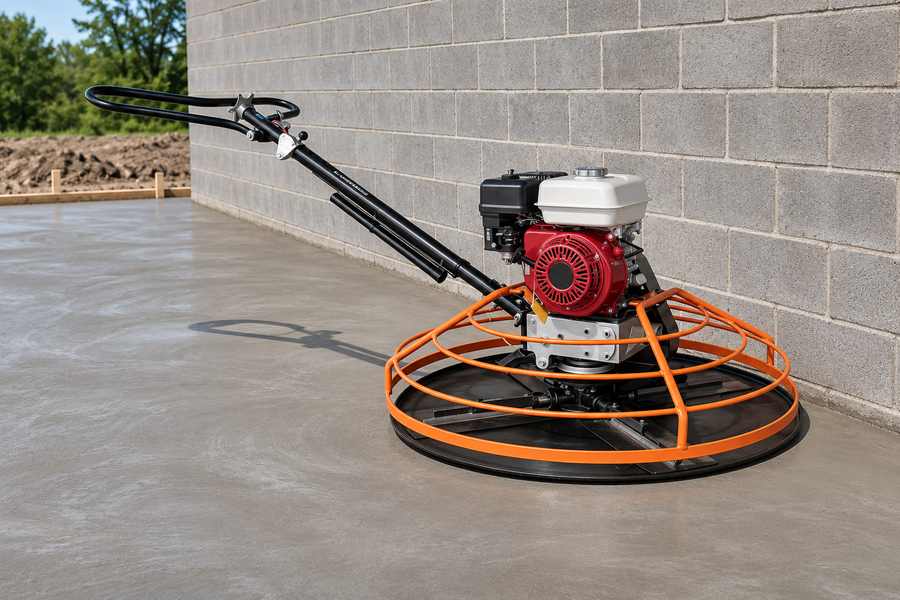
A walk-behind power trowel can finish close to a wall, but the actual clearance depends on its rotor diameter, guard ring design, blade configuration, and machine structure. Standard models may leave a narrow unfinished strip, while specialized edge-finishing machines with rotating guard rings can work much closer to walls.
Understanding these limitations helps contractors select suitable equipment and achieve a more consistent concrete finish.
What Determines How Close a Power Trowel Can Get to a Wall?
The minimum finishing distance is mainly determined by the relationship between the rotating blades and the machine’s outer protective structure. Several components influence wall clearance:
Guard Ring
The guard ring surrounds the rotating blades and protects the operator from accidental contact. On standard machines, the ring may contact the wall before the blades can reach the concrete immediately beside it.
Blade Diameter
Larger blade assemblies generally require more working space. Their wider finishing paths can make maneuvering around narrow spaces, corners, and wall intersections more difficult.
Machine Frame and Handle
The machine’s frame and handle arrangement affect how close the operator can position the rotor against a wall. Restricted handle movement may also make it difficult to maintain a consistent finishing path.
Blade Configuration
Float pans and finishing blades have different working characteristics. Their positioning and edge geometry can influence how close the machine can finish to an obstruction.
How Close Can Different Types of Power Trowels Finish?
There is no universal wall-clearance distance for all walk-behind power trowels. The actual measurement depends on the machine’s design and attachments. Some specialized edge-finishing models provide much smaller clearances than conventional machines.
For example, Allen Engineering’s PRO436E features rotating guard rings and specifies finishing clearances of approximately 5/16 inch when using 90-degree lip float pans and 3/4 inch when using blades. These figures apply to that particular machine configuration, not all walk-behind trowels. The following comparison illustrates the differences.
| Machine Type | Wall-Finishing Capability | Typical Application |
| Standard walk-behind trowel | Limited by guard ring and blade clearance | General slab finishing |
| Compact walk-behind trowel | Easier maneuvering in restricted areas | Small rooms and residential floors |
| Edge-finishing walk-behind trowel | Designed to finish very close to walls | Wall edges and columns |
| Ride-on power trowel | Requires additional clearance for its frame and blades | Large open floor areas |
| Hand trowel | Can reach the wall directly | Final edge correction |
A dedicated edging machine is generally the better option when minimal wall clearance is a project requirement.
Why Does an Unfinished Strip Remain Along the Wall?
Even when the main slab has been finished with a power trowel, a narrow strip may remain untreated along the perimeter. This happens because the machine cannot always position its rotating blades directly against the wall.
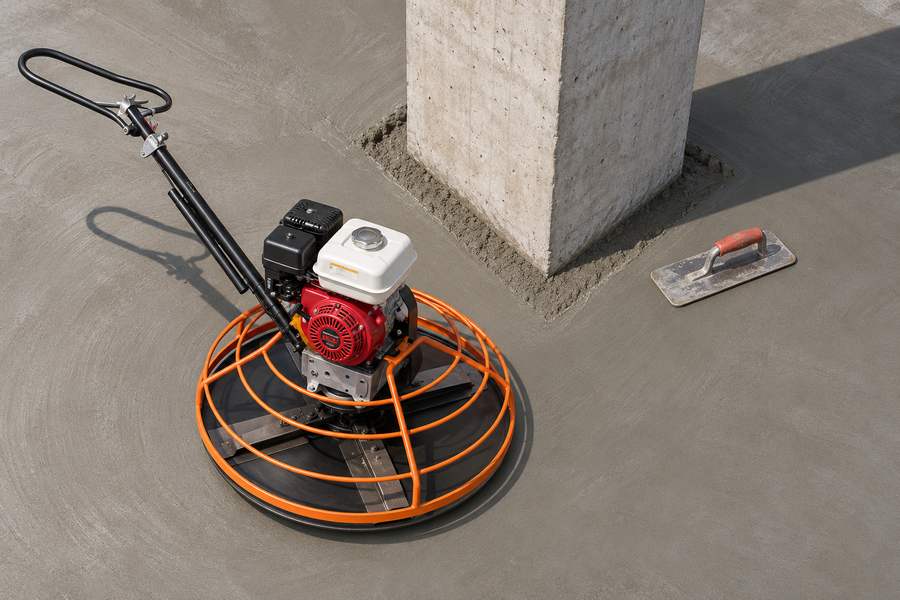
Several factors contribute to this problem: Guard ring interference: The outer ring reaches the wall before the blades can cover the remaining concrete. Limited maneuverability: Restricted working space prevents the operator from maintaining the ideal finishing path.
Wall projections: Door frames, columns, pipes, and other obstacles create additional clearance requirements. Blade positioning: The blade assembly may not extend sufficiently close to the perimeter. Uneven concrete setting: Concrete near walls may harden at a different rate because of environmental and placement conditions.
Leaving this strip unfinished can create visible differences in surface texture, color, gloss, and density. For polished concrete floors, the difference can become particularly noticeable because machine-finished and hand-finished areas may respond differently during polishing.
How Can Contractors Improve Wall-Edge Finishing?
Selecting the right machine and organizing the finishing sequence can significantly reduce unfinished perimeter areas.
Choose a Suitable Machine Size
Smaller machines are generally easier to maneuver around walls, columns, and narrow spaces. For example, Excalibur’s walk-behind power trowel range includes several working diameters:
| Model | Trowel Diameter | Suitable Applications |
| ST-24 | 600 mm | Small slabs and restricted spaces |
| ST-30 | 800 mm | Residential and commercial floors |
| ST-36 | 1000 mm | Medium-sized concrete surfaces |
| ST-48 | 1200 mm | Large industrial slabs |
The 600–800 mm models are easier to maneuver in tight spaces and near edges, while larger models cover wider areas more efficiently. However, a smaller rotor does not automatically guarantee a smaller wall clearance. The guard ring and overall machine geometry must also be considered.
Consider a Rotating Guard Ring
A rotating guard ring is particularly useful for edge-finishing operations. Unlike a conventional fixed arrangement, the rotating design allows the guard ring to move along the wall while the blades continue finishing the adjacent concrete. Its main advantages include: Reducing the gap between the blades and the wall.
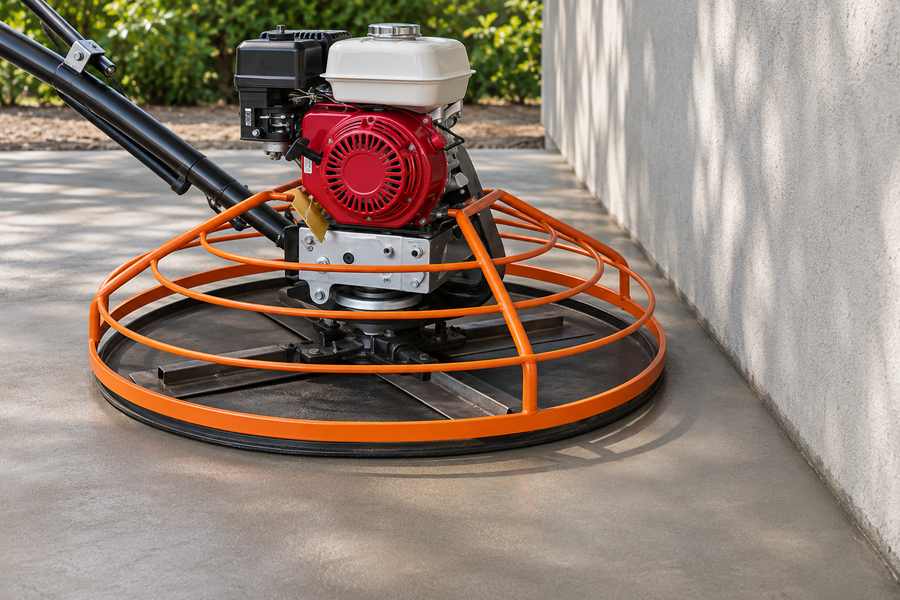
Protecting wall surfaces from direct machine contact. Improving maneuverability along slab perimeters. Reducing the amount of manual finishing required.
Along a long wall, a narrower hand-finished strip can save edging time and make the join with the machine finish easier to blend.
Adjust the Finishing Sequence
Contractors should plan the finishing sequence according to concrete setting conditions and machine accessibility. A practical approach includes: Complete the initial floating operation across the main slab. Identify perimeter areas that the main machine cannot reach.
Use a compact edge-finishing machine where appropriate. Finish remaining corners and narrow sections with hand tools. Check the transition between machine-finished and manually finished areas.
Complete final passes according to the concrete’s setting condition. Avoid waiting until the surrounding slab has become too hard before addressing unfinished edges.
How Can Contractors Match the Edge Finish with the Main Slab?
Achieving a consistent finish requires more than simply reaching the wall. The perimeter should also match the appearance and surface characteristics of the main slab.
Control Blade Pitch
Blade pitch affects the pressure applied to the concrete surface. Excessive pitch on relatively soft concrete may create scratches, surface tearing, or uneven marks. Begin with an appropriate setting for the current concrete condition and increase the pitch gradually during subsequent finishing passes.
Maintain Consistent Finishing Timing
Concrete near walls, corners, and openings may not harden at exactly the same rate as the central slab. Check the surface condition before finishing each area. Applying the same machine settings at different stages of concrete hardening may produce inconsistent results.
Minimize Differences Between Manual and Machine Finishing
Hand-finished areas can have different surface density and appearance compared with mechanically troweled sections. To reduce these differences: Use appropriately sized hand trowels. Maintain consistent finishing pressure.
Avoid excessive repeated hand troweling. Coordinate each hand pass at the wall with the corresponding pass on the open floor. Look across the joint in raking light for a ridge or a change in sheen.
The American Society of Concrete Contractors recommends using walk-behind edge-finishing equipment with rotating guard rings to reduce manual finishing around walls and other obstructions.
What Should Contractors Check Before Choosing an Edge-Finishing Trowel?
Before purchasing or renting equipment, evaluate the actual working conditions rather than choosing a machine based only on its advertised diameter. Use the following checklist: Required wall clearance: Determine the maximum acceptable unfinished strip. Working diameter: Select a rotor size suitable for the available space.
Guard ring design: Check whether the ring is fixed, rotating, or equipped with protective bumpers. Blade compatibility: Confirm whether the machine supports float pans, finishing blades, or specialized edge attachments. Maneuverability: Evaluate handle movement and access around columns and door openings.
Concrete finish requirements: Consider whether the project requires a standard smooth finish, a dense industrial surface, or a polished concrete base. Machine safety: Never remove protective guards or modify rotating components to achieve smaller clearances.
For large slabs with extensive wall boundaries, combining a main walk-behind trowel with a dedicated edge-finishing machine can be more practical than relying entirely on manual work. A walk-behind power trowel can finish within a very small distance of a wall when equipped with a suitable edge-finishing design.
Rotor size, guard ring construction, blade configuration, and concrete conditions determine the actual clearance. Selecting the right machine and coordinating edge-finishing operations helps contractors achieve more uniform concrete surfaces with less manual work.