
A generator can have enough rated power and still struggle to start a tool when an extension cord loses too much voltage. Cord length, conductor size, starting current and connector condition all affect the voltage that reaches the load. Diagnose the generator and the cable separately before assuming that a larger generator will solve the problem.
This guide concerns portable equipment connected through approved cord sets, rather than a building supply installation. The practical aim is to deliver usable power at the tool while keeping the generator in a safe outdoor location.
What Does a Cord Problem Look Like?
A tool that starts normally on a suitable short cord but struggles on a longer one gives you a useful clue. A motor may accelerate slowly, a compressor may fail to restart, or electronic equipment may shut down when another load starts. These symptoms suggest a supply problem, but they do not prove that the cord is the only cause.
| Observed Behavior | Possible Explanation | Useful Next Step |
| Several loads weaken together | Generator output or total demand | Reduce connected loads and review starting requirements |
| Only the distant tool struggles | Cord loss, connector fault or tool problem | Compare with a suitable shorter cord |
| A plug is discolored or smells hot | Damaged or resistive connection | Disconnect safely and remove the cord from service |
| A motor hums without accelerating | Insufficient starting voltage or mechanical trouble | Stop the attempt rather than repeatedly restarting |
Record which loads were running when the symptom appeared. A report that says “the saw struggles when the compressor restarts” is much more useful than “the generator is weak.” It identifies the event that the power system must handle.
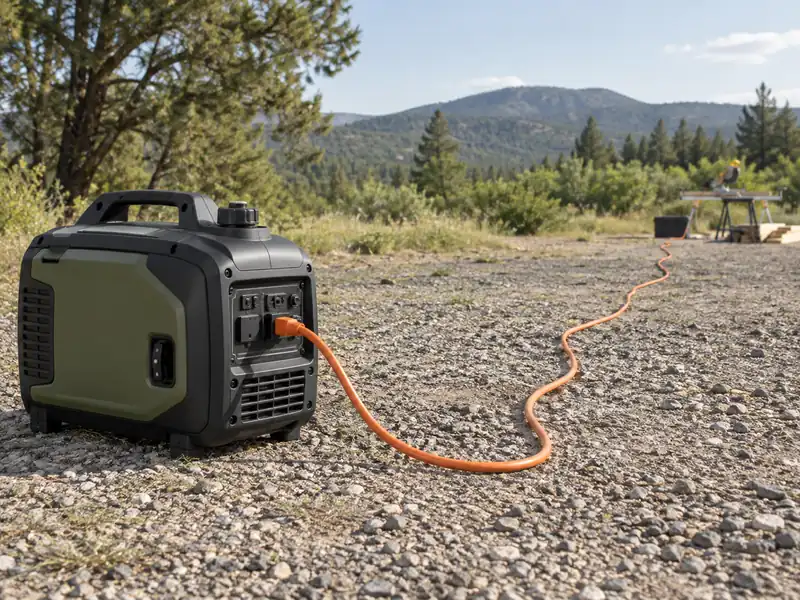
Why Does a Longer Extension Cord Lose More Voltage?
A conductor has resistance, so current flowing through it produces a voltage difference between its ends. A longer circuit adds resistance, while a larger conductor cross-section reduces it. The return path matters as well as the outward path.
How Does Starting Current Change the Picture?
Many motors draw substantially more current while starting than after reaching speed. That temporary demand increases cable voltage drop and may coincide with a brief fall in generator terminal voltage. A running-watt total therefore cannot fully describe whether a motor will start successfully.
Starting behavior varies with motor design and mechanical load; there is no multiplier that safely represents every appliance. Use the equipment manufacturer’s starting information, including any compressor restart restrictions. The site’s generator sizing guide provides the broader context for separating continuous loads from startup demand.
Can an Inverter Generator Eliminate Cable Loss?
No: controlling the waveform does not remove resistance from the extension cord. An inverter generator may regulate its output well while the voltage at a remote appliance still falls under load. Compare both the power source and the delivery route.
When reviewing Excalibur inverter generators, confirm the specific model’s continuous rating, startup capability, outlet limits and operating instructions. Do not assume that every outlet can supply the generator’s total advertised power. Likewise, a larger machine cannot make an underrated cord suitable.
What Can a Simple Voltage-Drop Example Tell You?
For an illustrative single-phase circuit, suppose the total outward-and-return conductor resistance is 0.40 ohm. At 10 amps, the basic resistive calculation gives a 4-volt drop; at 30 amps, it gives 12 volts. On a nominal 230-volt supply, these correspond to about 1.7% and 5.2% respectively.
- Voltage drop in this simplified example equals current multiplied by total circuit resistance.
- The stated resistance includes both current-carrying conductors; it is not the resistance of one conductor alone.
- The 30-amp case illustrates a temporary higher demand, not an approved continuous rating for any particular cord.
This is a teaching example, not a cable selection table or a prediction of a particular motor’s starting current. Actual starting voltage also depends on generator response, conductor temperature, connections, power factor and circuit impedance. Have a qualified person perform the applicable cable calculation when the load or cable route is demanding.
The example explains why a cord can appear satisfactory with a light load yet cause trouble during startup. It also explains why replacing a long thin cord with a correctly rated larger-conductor cord can help without changing the generator. The improvement must still be confirmed against the equipment’s permitted voltage range.
How Do You Separate Generator Sag from Cord Loss?
Compare behavior under the same load conditions, changing one variable at a time. Begin with the equipment stopped and the cord disconnected before inspecting plugs, insulation and ratings. Remove damaged cords from use instead of attempting a temporary repair with tape.
- List the connected equipment, operating current and known startup requirements.
- Confirm generator voltage, frequency, outlet rating and any manufacturer guidance for starting heavy loads.
- Remove unnecessary loads and retry only if there is no overheating, damage or stalled motor condition.
- Use a known-good cord of suitable rating and shorter length where the safe site layout permits.
- If the fault remains, have a qualified technician compare generator-terminal and load-end voltage during the same operating event.
A normal no-load voltage reading does not establish that power remains satisfactory during startup. Conversely, low voltage at the generator under the same event points toward a source or load issue rather than a cable-only explanation. Do not open live plugs or panels to obtain measurements.
Generator capacity may also change with operating conditions. If the same arrangement behaves differently at elevation, consider altitude-related engine power loss alongside the cord investigation. Several modest limitations can combine into one noticeable starting problem.
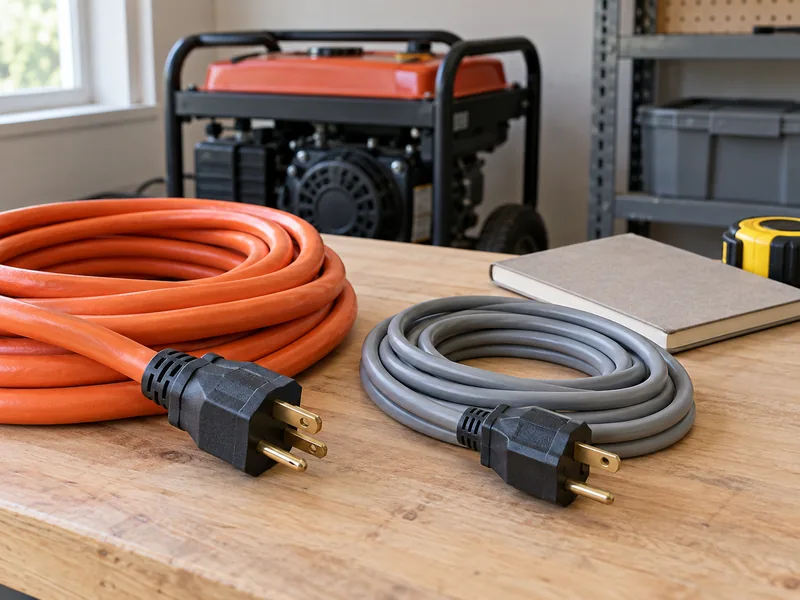
How Should You Choose the Replacement Cord?
Choose a factory-made cord set suited to the supply, load, environment and required distance. Read its conductor size, current rating and relevant markings rather than judging by the thickness of the outer jacket. Insulation thickness alone does not reveal the amount of conductor inside.
- Match plugs and connectors to the outlet and equipment; improvised adapters can introduce another limitation.
- Choose a length that reaches safely without unnecessary extra distance or multiple joined cords.
- Check any reel’s separate wound and unwound ratings, and fully unwind it as directed for the load.
- Protect the route from vehicle damage, sharp edges, standing water and trip hazards.
OSHA’s portable generator guidance calls for intact, appropriately rated grounded extension cords and warns against generator overload. Its guidance supports the basic selection principles; it does not replace the cord and equipment manufacturers’ instructions or local electrical requirements.
For a conventional source, the same cable principles apply to gasoline generators. Verify the exact outlet configuration and load compatibility before connecting equipment. Never increase a breaker rating to stop nuisance trips.
Which Fixes Create a Different Problem?
Shortening a cord must never mean bringing an engine-driven generator indoors or closer to an opening. The CDC advises outdoor operation at least 20 feet from doors, windows and vents. Plan the cable around a safe generator position, with exhaust directed away from occupied areas.
Do not raise generator output voltage outside its approved setting to compensate for a cable problem. A lightly loaded appliance could then receive excessive voltage, and the original connector or heating fault would remain. Do not bypass protective devices or feed a building through a wall receptacle.
Finally, avoid treating every equipment shutdown as a waveform problem. Generator THD and sensitive electronics concerns waveform distortion, whereas cord drop concerns voltage lost in the supply path. Both can matter, but improving one does not automatically correct the other.
What Should You Record After the Problem Is Resolved?
Keep a short operating note with the successful cord length and rating, connected loads, startup sequence and generator mode permitted by the manual. Include the equipment identities so another crew does not apply the arrangement to a different motor. A repeatable setup is more useful than simply recording that a thicker cable worked.
If an adequately rated arrangement still struggles, stop substituting cords and ask for a generator-and-load compatibility assessment. Supply the symptom and the conditions that trigger it. That gives the technician a concrete starting point for identifying the remaining limitation.